Machines for packaging food in bags are primarily divided into two types. The first type consists of form, fill, and seal (FFS) machines that use roll stock—such as polyethylene film or composite plastic—to form bags, fill them with measured quantities of powder, granules, or liquid products, and optionally degas (including re-inflation) before sealing and cutting. The second type includes machines for sealing preformed bags, which fill, degas (with possible re-inflation), and seal preformed bags, or simply seal them.
Heat-sealing methods for plastic films
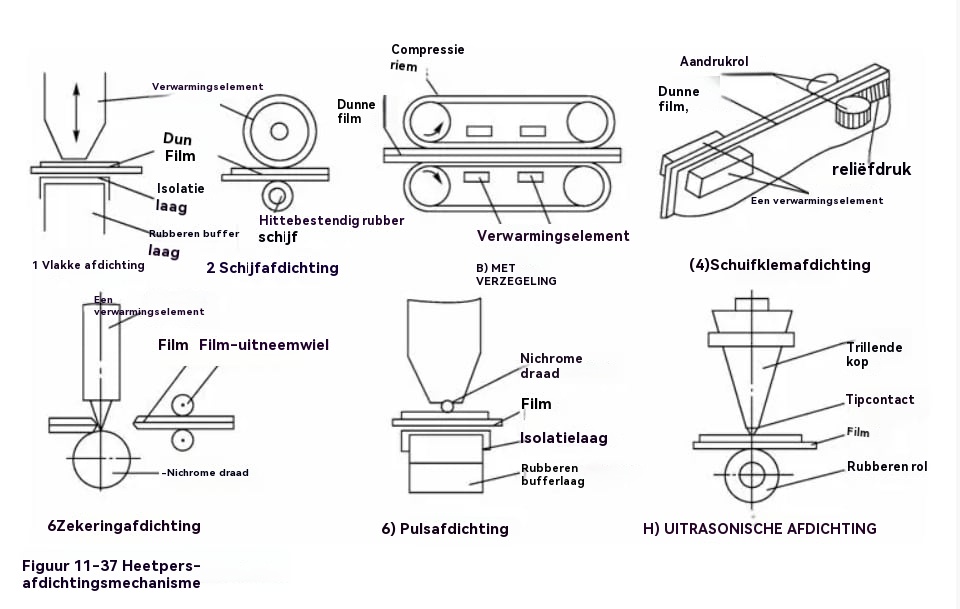
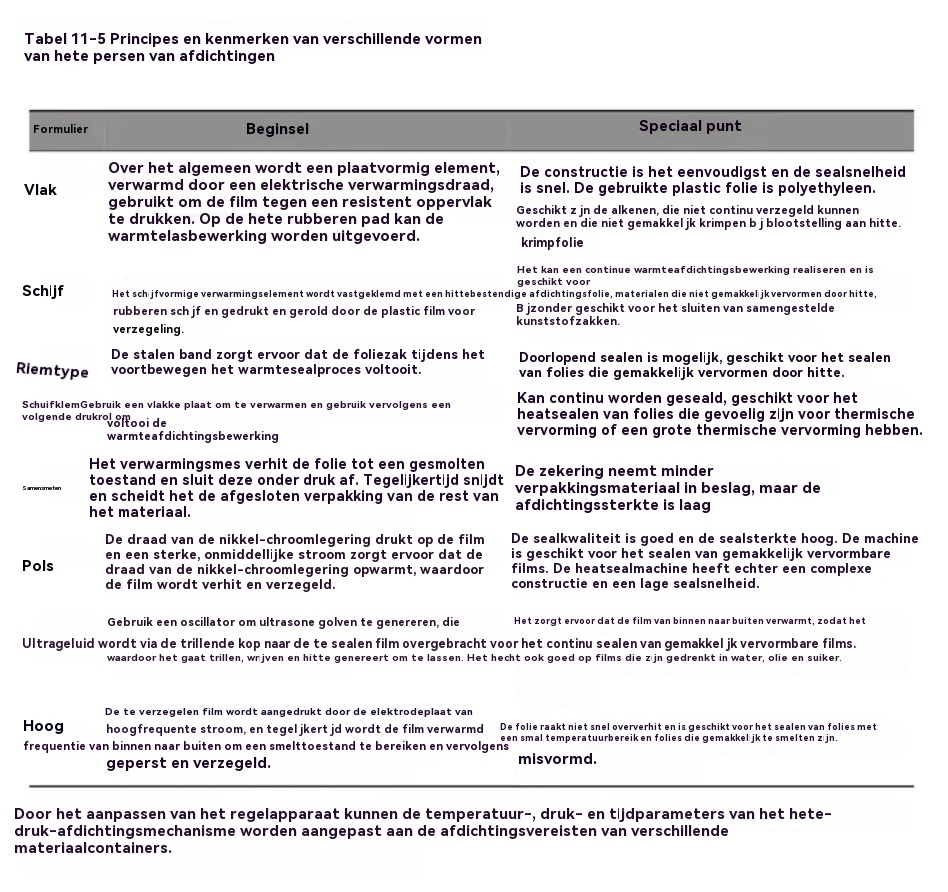
Both form-fill-seal machines and machines for sealing pre-made bags use heat-sealing mechanisms to thermally bond packaging materials. As illustrated in Figure 11-37, typical heat-sealing techniques include flat-plate, roller, band, sliding clamp, and hot-cut methods. Table 11-5 summarizes the principles and characteristics of these sealing methods. By adjusting control parameters such as temperature, pressure, and timing, the sealing process can be optimized for different packaging materials and container types.
Form-Fill-Seal Packaging Machines
Automatic form, fill, and seal packaging machines use roll-fed packaging films to autonomously form, fill, seal, and cut bags. This packaging style is suitable for powders, granules, blocks, liquids, and colloidal substances, and is often used for small food items, granulated beverages, and instant products. The films used can be made of plastic or composite materials. Depending on the machine, bags are formed using one or two film rolls, with single-roll machines being the most common.
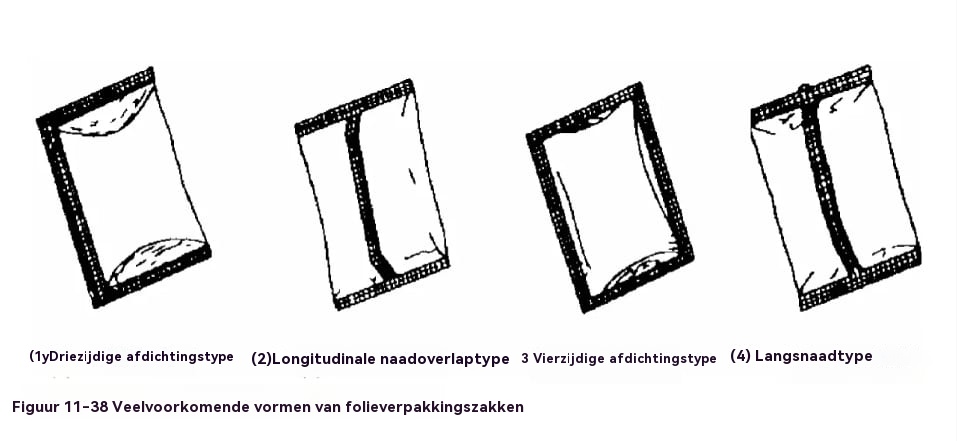
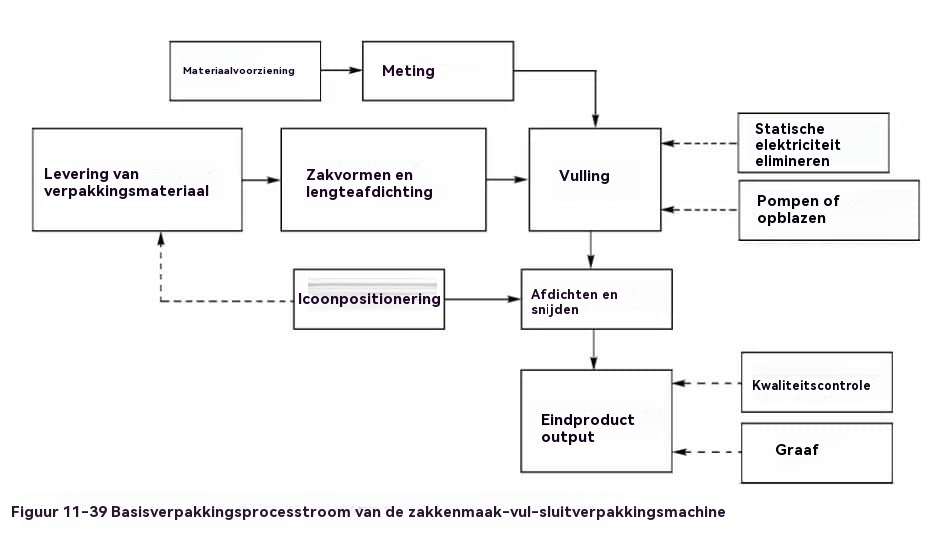
These machines produce various types of bags, the most common of which are center-seal, four-side-seal, and three-side-seal bags (see Figure 11-38). Although the specific machine configuration varies by bag type, the core components and operating principles are generally consistent. Figure 11-39 shows a typical packaging process for a form-fill-seal machine. There are variations in structure and process depending on the model, but the underlying packaging methodology remains similar.
Forming, filling, and sealing machines are categorized based on their configuration (vertical or horizontal) and the type of motion (continuous or intermittent bag forming).
Composition and Structure of Forming, Filling, and Sealing Machines
Despite the variety of models, designed for different materials and bag types, forming, filling, and sealing machines share fundamental components. For example, a typical vertical, continuous form, fill, and seal machine (Figure 11-40) consists of a drive system, a film feed mechanism, bag forming and sealing units, a material dosing system, and an electronic control and detection system. Drive and transmission units in the machine cabinet drive vertical and cross-seal rollers and volumetric feeding systems. The film roll on the unwinding frame rotates smoothly, and the film is guided through rollers that tension, straighten, and precisely align it.
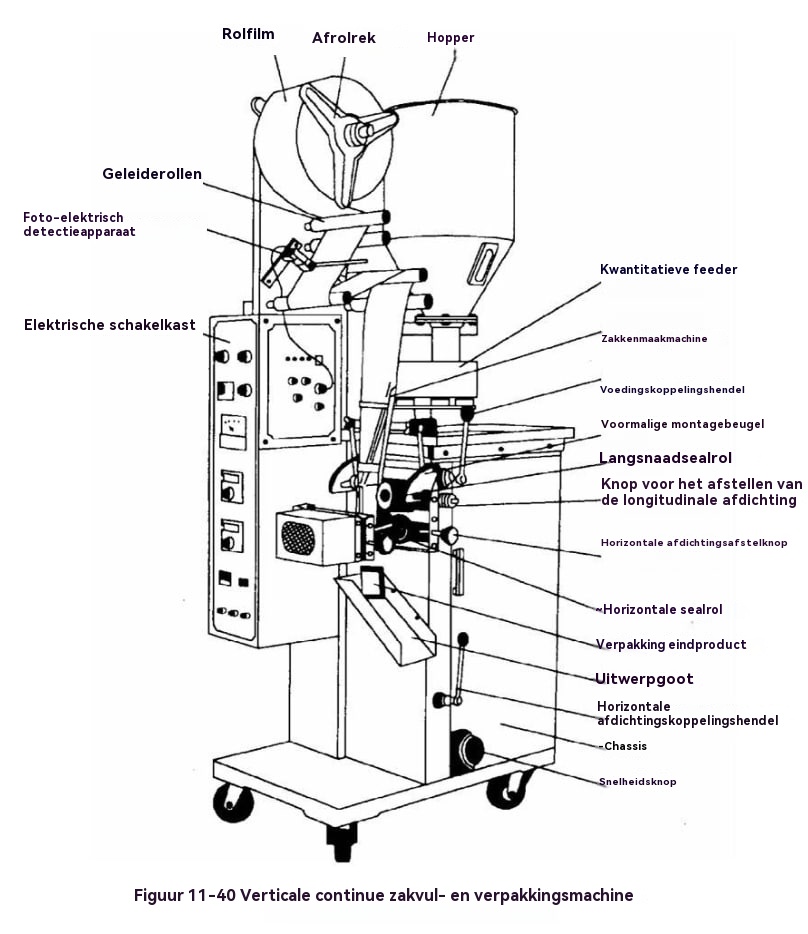
The bag-forming and sealing system consists of a bag former and vertical and horizontal sealing devices. Different combinations make it possible to produce various bag shapes and sealing styles, which is often used to distinguish between different machine types.
The material is fed using volumetric dosing devices, typically adjustable volumetric cups for powders and granules. In the rotary disc feeder shown, the material moves from the hopper to volumetric cups arranged around the circumference of the disc and then automatically fills the formed film tube.
The electronic control system is the heart of the machine and allows for the adjustment of parameters for vertical and cross-seal temperatures. It can also detect color markings on printed films. This ensures consistent packaging quality.
Principles of Shaping, Filling, and Sealing
Horizontal Forming, Filling, and Sealing
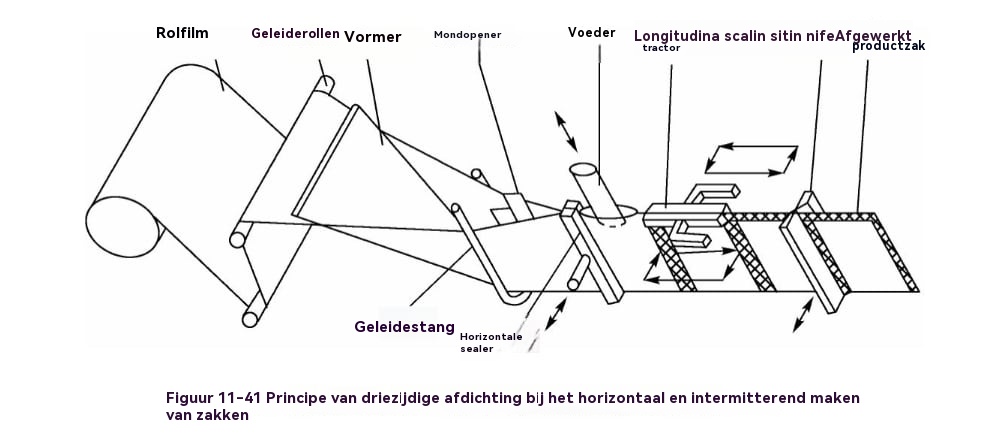
a. Three-sided seal bags: As shown in Figure 11-41, plastic film is fed from a roll into the mold, where it is formed into a U-shape and opened by a spreader. When the filling machine lowers to the filling position, the cross sealer closes while the material is being filled; then both the cross sealer and the filling machine are reset. Next, the vertical sealer closes to heat-seal the film and advance it by one bag length, after which the sealed bag is cut off.
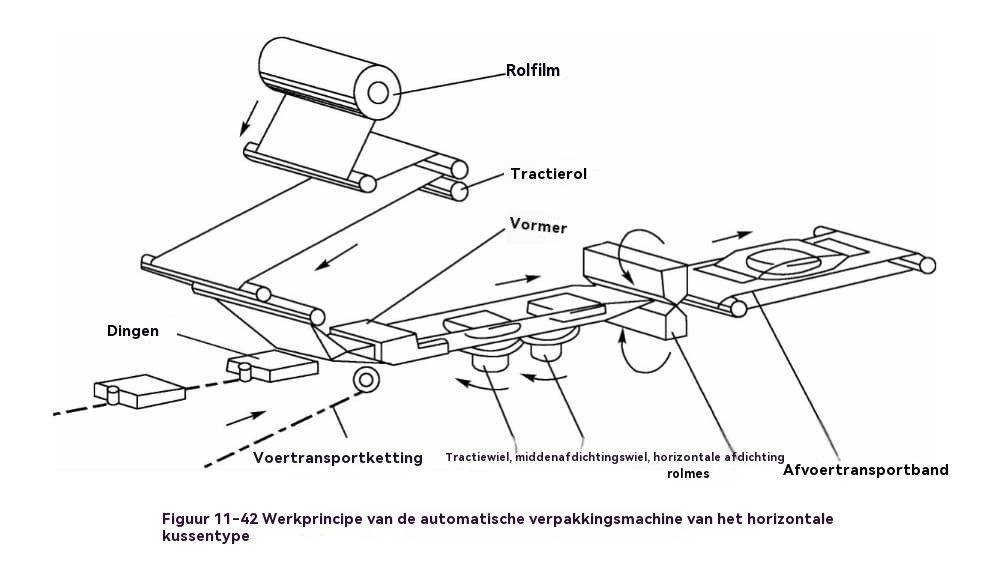
b. Horizontal pillow pockets: Figure 11-42 illustrates a horizontal pillow-pack machine. This continuous-operation machine automatically wraps, seals, and cuts products such as cookies and instant noodles. Film from a roll is fed into the forming machine and shaped into a roll wrap around the products being transported by a feed conveyor. The film moves forward under traction, with the center seam being sealed by a sealing wheel. Cross-sealing and cutting result in the final pillow-style package, which is discharged by a conveyor belt. When using colored marking tape, an optoelectronic detection system adjusts the film length in real time to ensure precise positioning.
Vertical Forming, Filling, and Sealing
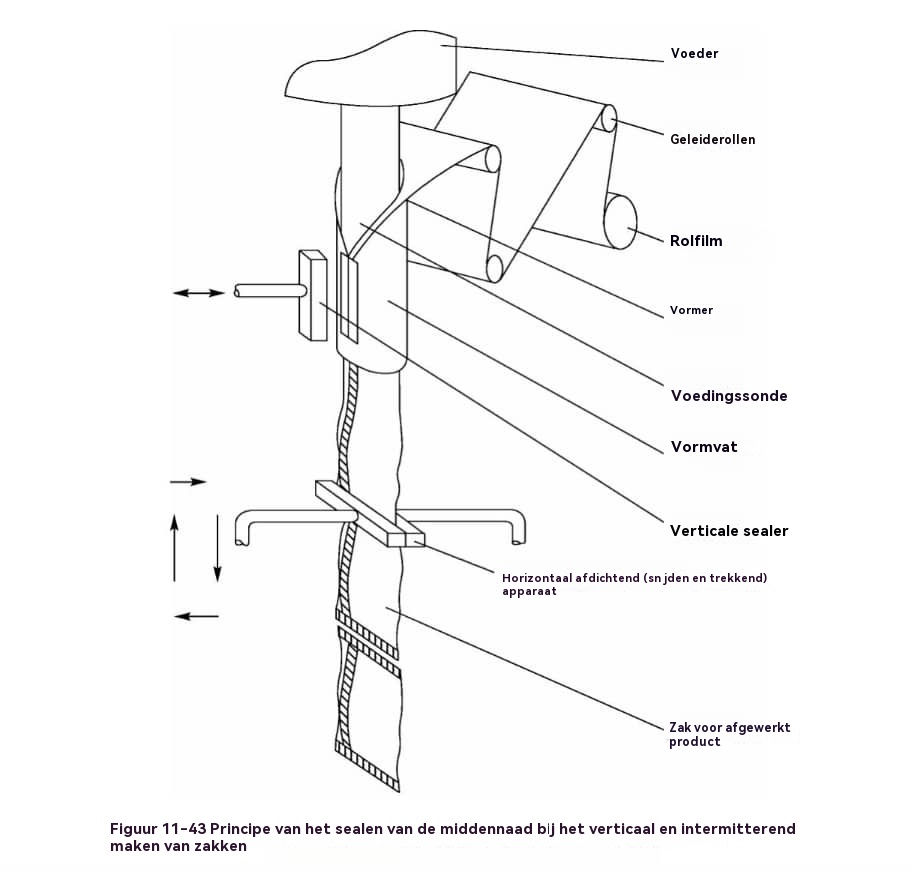
a. Intermittent bag forming with center seam sealing: As shown in Figure 11-43, plastic film is fed from a roll into the mold to form a cylindrical shape with an overlapping center seam. The filling tube serves both as a bag former on the outside and as a material feed on the inside. The vertical sealer presses down on the overlapping film to heat-seal vertically, retracts, and then seals crosswise while the horizontal sealer pulls the film down one bag length, sealing and cutting the bags. Each cross seal simultaneously seals the bottom of the top bag and the top of the bottom bag, while filling takes place during film feed.
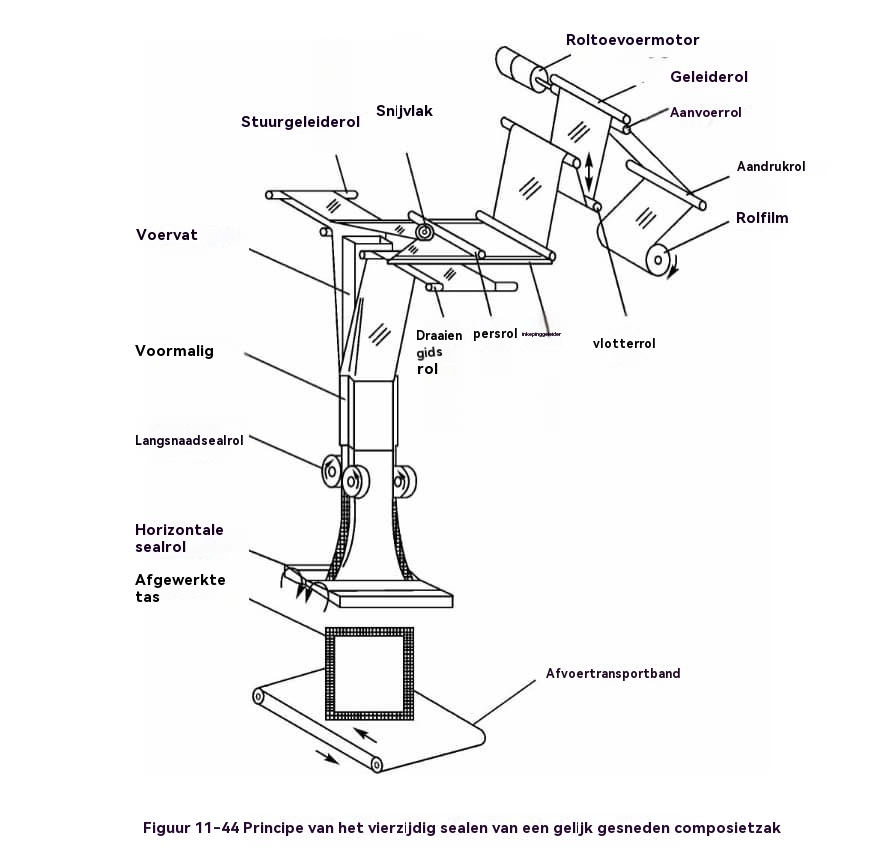
b. Forming Quad Seal Bags: Machines that produce quad-seal bags can use two symmetrically positioned rolls of film that are sealed lengthwise, then cross-sealed, and cut after filling. A single-roll quad-seal machine (Figure 11-44) splits the film down the center and rejoins the halves while forming the bag.
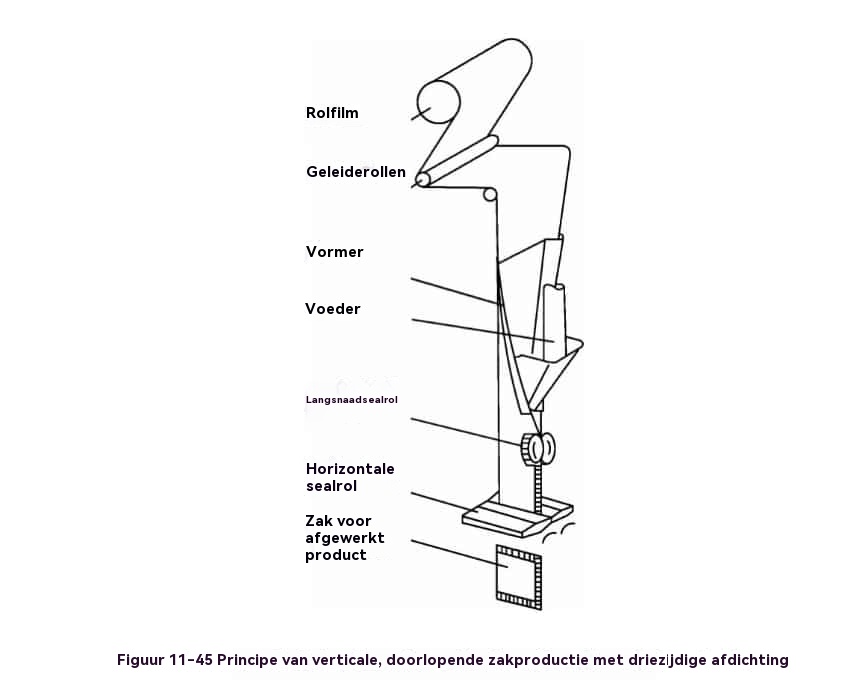
c. Forming single-roll, three-sided bags: Using a single roll of film, this method produces either three-side sealed bags or “fake sealed” quad-seal bags (Figure 11-45). Pillow packaging (Figure 11-46) involves longitudinal sealing after the forming process, followed by cross-sealing and cutting, resulting in center-seam folded bags with sealed ends.
Machines for sealing pre-made bags
These machines seal pre-filled plastic bags and include standard sealers, vacuum packaging machines, and vacuum-inflation packaging machines. Standard sealers with simple heat-sealing devices are not discussed in detail here.
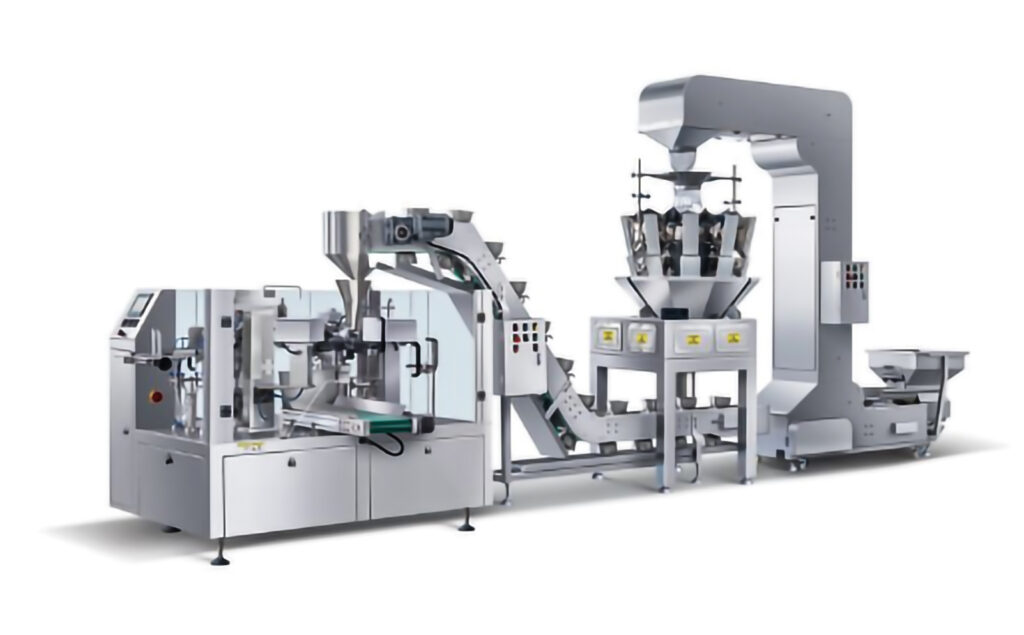
Vacuum packaging machines often combine vacuum and inflation functions and are available in intermittent and continuous models.
Intermittent vacuum-inflation packaging machines
These machines use composite film bags, which are filled and manually placed on the heat-sealing bar of the vacuum chamber, after which they are automatically evacuated, inflated, and sealed. The size and number of bags per cycle vary. This method is suitable for solids, granules, semi-liquids, and liquids, and is widely used in food production due to its flexibility and ease of use.
Types of Intermittent Vacuum Blowing Machines
Figure 11-47 shows the most common types: tabletop model, single-chamber model, double-chamber model (single or double lid), and inclined model (conveyor belt model). The vacuum level reaches an absolute pressure of 1–2 kPa, with production speeds of 2–4 cycles per minute.
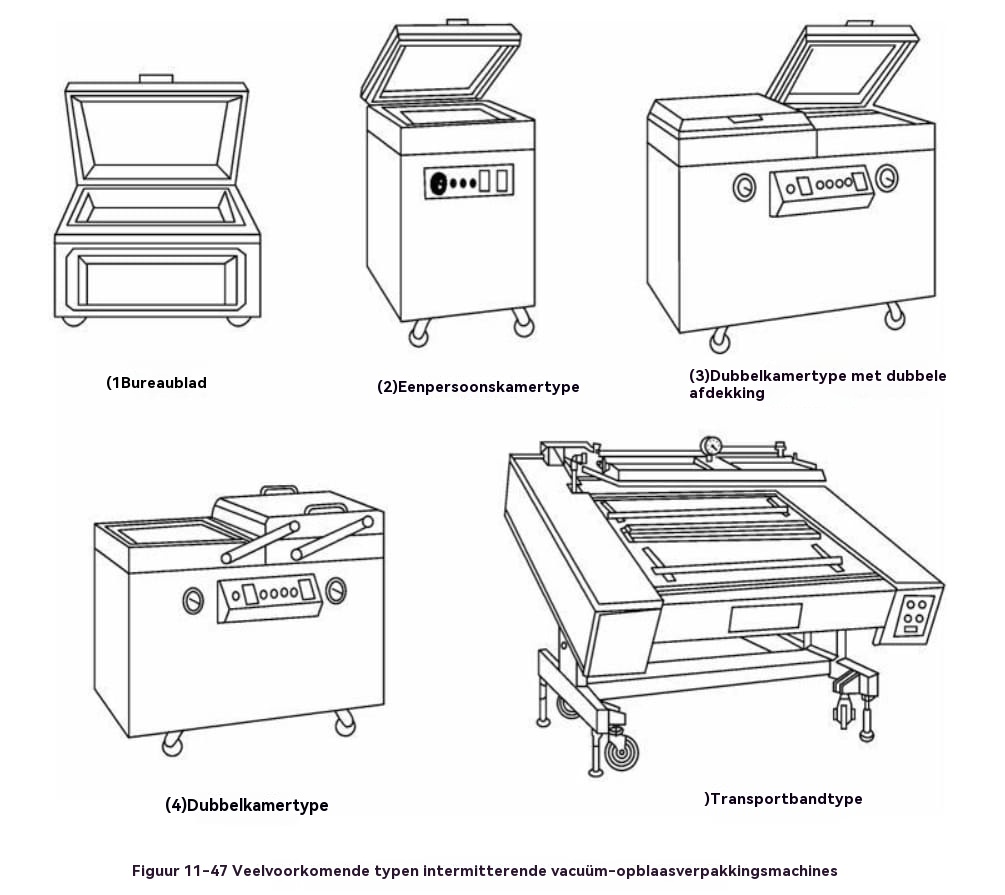
Benchtop models and single-chamber machines have a single short heat-sealing bar, suitable for use in laboratories or for small batches. Dual-chamber machines share the vacuum and inflation system, which improves efficiency because one chamber is sealing while the other is being loaded or unloaded.
The horizontal bottom of the vacuum chamber makes it difficult to seal products with a high liquid content, because the sealing nozzle must be kept above the bottom of the chamber to prevent leakage. This limits its suitability for products with a high liquid content.
Vacuum-sealing machines with conveyor belts (sloped) automatically feed products into the chamber, which increases automation and throughput. The sloped chamber floor prevents liquid from spilling during sealing.
Operating Principle of Intermittent Vacuum Inflation Machines
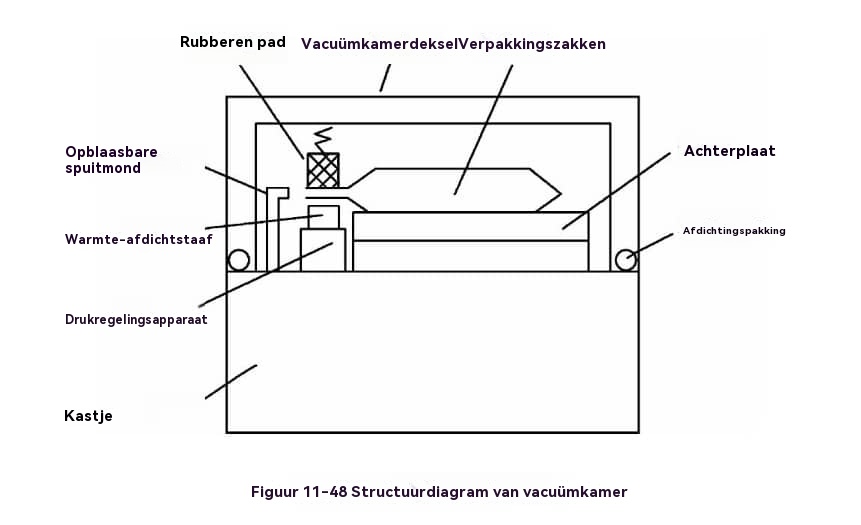
With the exception of the models with a conveyor belt, these machines consist of a main unit, a vacuum chamber, a heat-sealing device, a lid-lifting mechanism, a vacuum system, and electronic controls.
The vacuum chamber (Figure 11-48) is where the sealing takes place. Figure 11-49 illustrates the vacuum-inflation-sealing cycle, which consists of:
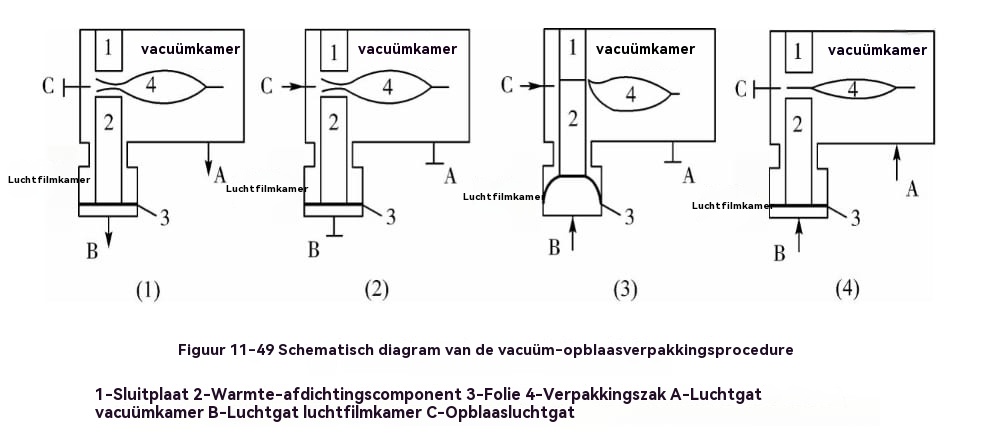
a. Vacuum Pumps: Evacuates the vacuum chamber and the lower air film chamber to equalize the pressure and prevent the film from bulging and losing vacuum. The vacuum level is set to -0.097 to -0.0987 MPa.
b. Inflation: After sealing air vents A and B, inert gas is blown into the package at a pressure of 3–6 kPa, controlled by a timer. The vacuum in the chamber is maintained between -0.097 and -0.094 MPa. The gas-filling step is skipped for cooked products that will be sterilized later.
c. Thermal Insulation and Cooling: With vent hole B open, atmospheric pressure presses the film against the sealing pad while the sealing bar heats up to seal. After sealing, the power is turned off to allow cooling while maintaining pressure, which ensures a strong seal.
d. Bleeding: Air flows into the vacuum chamber, keeping the pressure balanced, causing the lid to open, and allowing the sealed package to be removed.
Rotary Vacuum Packaging Machines
Figures 11-50 and 11-51 show a rotary vacuum packaging machine with a filling and vacuum turntable. A mechanical arm transports filled bags between stations.
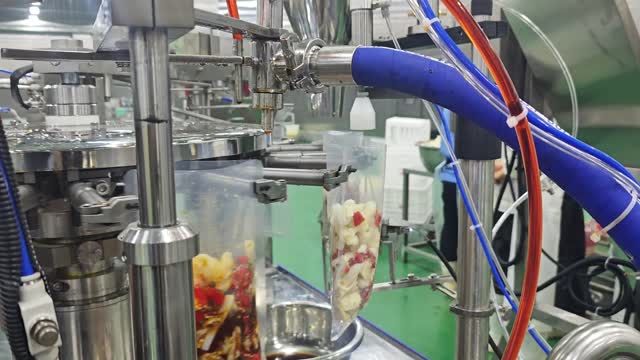
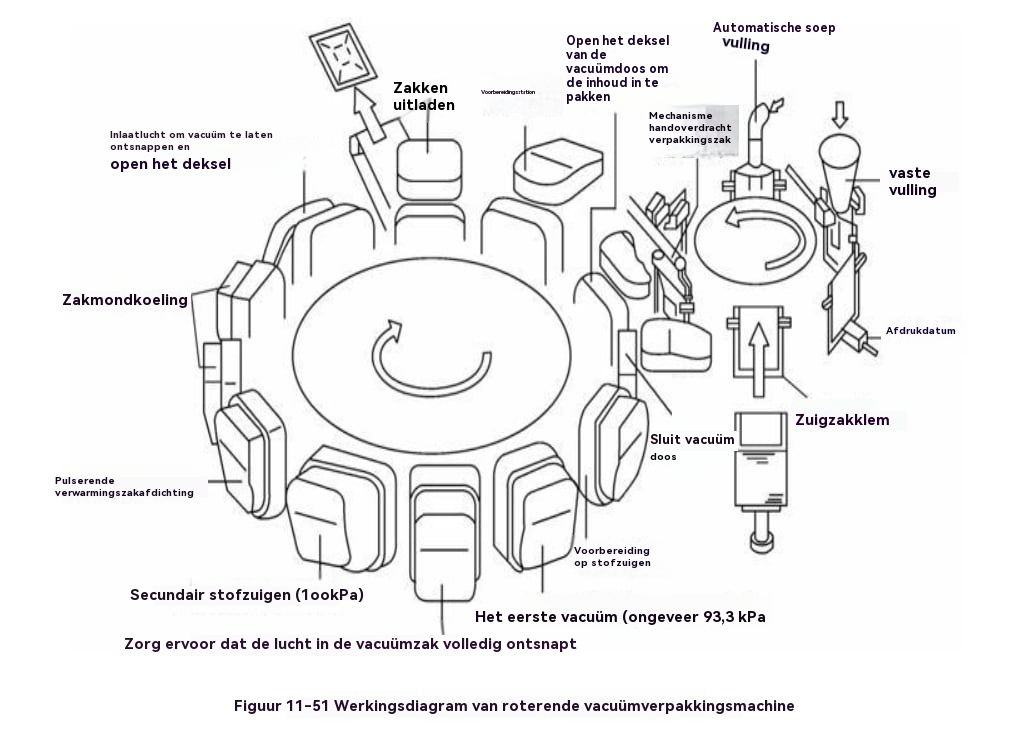
The filling rotary table includes 6 stations for feeding, printing, opening, filling with solids, and injecting liquids. The vacuum rotary table has 12 vacuum chambers where vacuum pumping, heat sealing, cooling, and unloading take place in cycles, with a capacity of up to 40 bags per minute. The dosing of solids must be coordinated with the filling station.
Thermoforming packaging machines
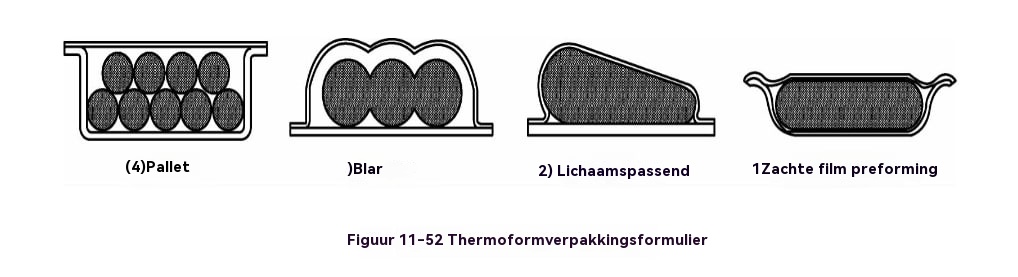
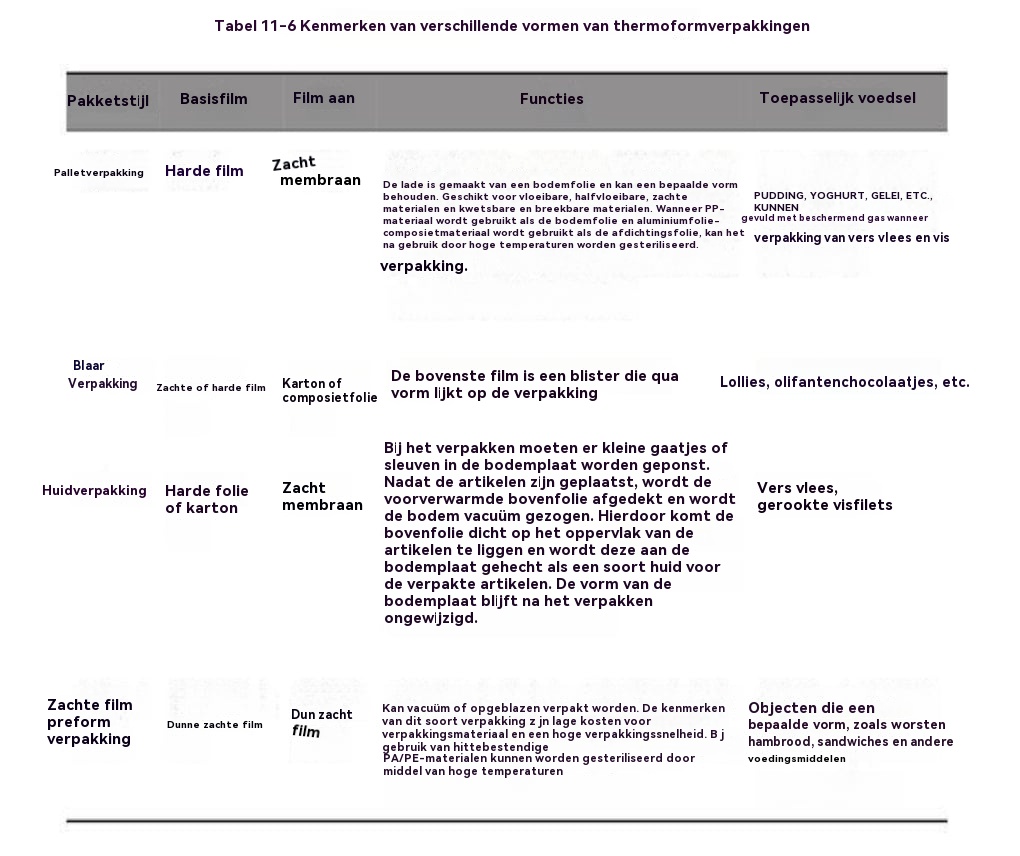
Thermoformed packaging is made using thermoplastic sheets to form containers, which are then filled and sealed with film or sheets. Common types include tray, blister, skin, and soft-film packaging (Figure 11-52). Table 11-6 compares their characteristics.
Thermoforming equipment ranges from manual to fully automatic. The process involves clamping, heating, applying pressure or creating a vacuum, cooling, and demolding. These machines produce only packaging containers; separate equipment is required for filling and sealing.
Fully automatic thermoforming machines combine forming, filling, and sealing using roll-fed thermoplastic films to form the bottom and seal the top. This integration eliminates the need for pre-made boxes and streamlines production for food manufacturers. These versatile machines support a variety of packaging formats, as shown in Figure 11-52.
Figure 11-53 shows a fully automatic thermoforming machine with components such as film transport, film guidance, bottom film preheating, forming, filling, heat sealing, cutting, and control systems.
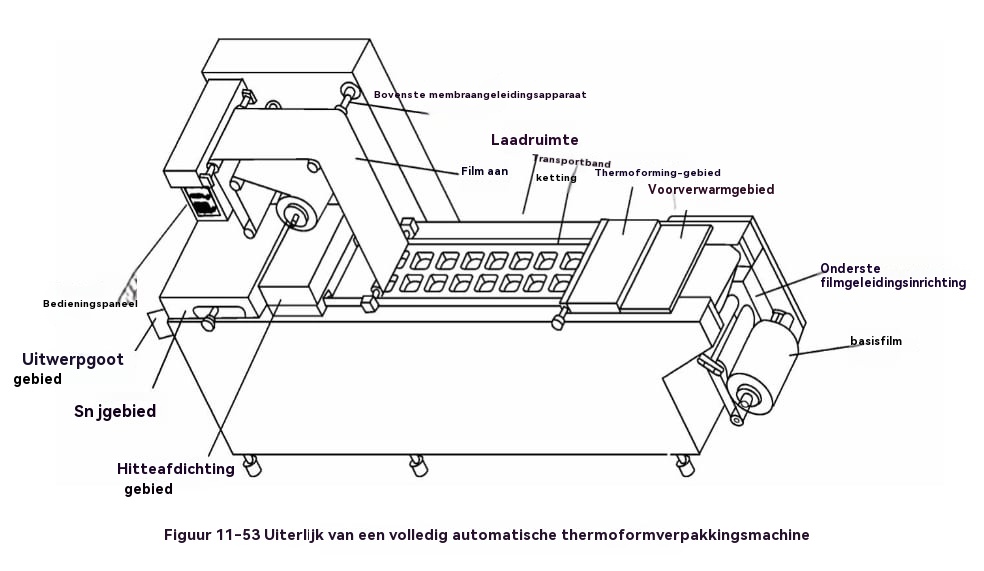
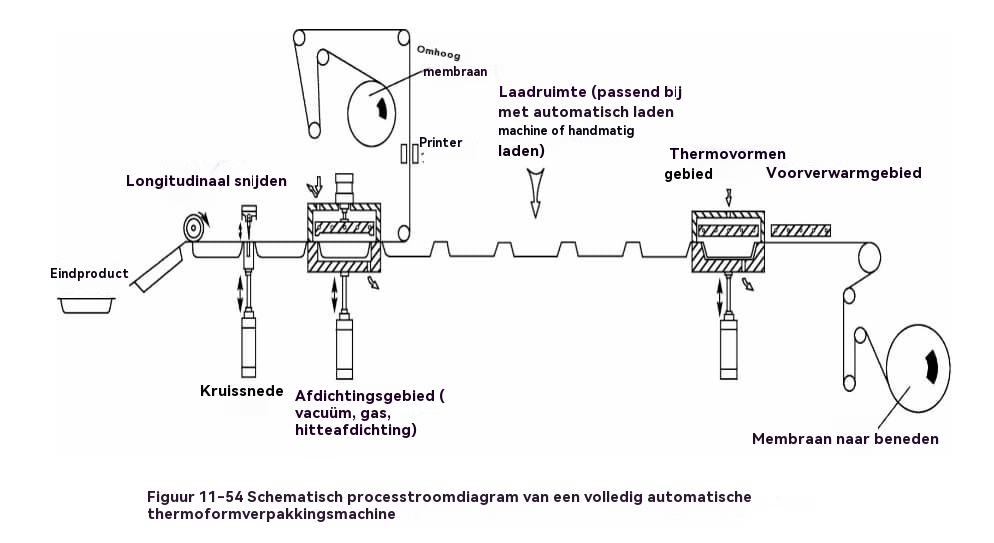
Figure 11-54 illustrates the packaging process: the bottom film is drawn through preheating and forming zones (air pressure, vacuum, or die-cutting), the filling zone is filled, and the package is then covered with the top film. A vacuum or protective gas treatment can be applied before heat sealing. Finally, the packages are formed by cross-cutting, longitudinal cutting, and corner trimming. Trimmings are collected via suction or wrapping.






 English
  Dutch
Dutch