In the modern packaging industry, a variety of machines are used to automate various processes that ensure products are properly labeled, sealed, and protected for distribution. Labeling machines, shrinkpackaging machineSealing machines and strapping machines each perform essential functions in the packaging line: they optimize efficiency and maintain product integrity. From applying labels to packaging to tightly sealing shrink wrap and securing boxes for transport, these machines help improve packaging quality and streamline production. Understanding the features, types, and applications of each machine is crucial for companies that want to improve their packaging processes and comply with industry standards.
Labeling Machine
A labeling machine is a machine that applies labels—containing the name, ingredients, functions, instructions for use and opening, trademark logos, etc., of the food inside the package—to a specific part of the package. See the image of the labeling machine.
There are many different types of labeling machines, depending on the packaging purpose, the type of packaging container, and the type of labeling adhesive.
Commonly used labeling machines are classified as follows:
(1) Depending on the degree of automation of the operation, they are classified as semi-automatic labeling machines and automatic labeling machines;
(2) Depending on the type of packaging, they can be classified into labeling machines for cans made of thin tin-plated steel sheets, labeling machines for glass bottles and cans, etc.;
(3) Depending on the direction of the container’s movement, they can be classified as horizontal labeling machines and vertical labeling machines; (4) Depending on the container’s movement pattern, they can be classified as straight-line labeling machines and turntable labeling machines.
The following are commonly used labeling machines:: (1) Portal labeling machine; (2) Rotary fork labeling machine; (3) Vacuum suction labeling machine and press labeling machine; (4) Rotary labeling machine; (5) Vacuum barrel labeling machine, etc.
Portal Labeling Machine
As shown in the figure, the label is stored in the label box 2; it is pressed down by the weight 3 and slides down the ramp. The label roll 1 rotates continuously, dispenses the labels one by one, passes them downward through the label pull roller 4 and the coating roller 5, coats them with adhesive, and then feeds them into the label guide 8, where they remain upright. As the bottle is fed through the gantry—or label guide—via the conveyor belt, the label is carried along with the bottle and then fed through the channel between the two rows of brushes 10, where it is smoothed over the surface of the bottle by the brush.
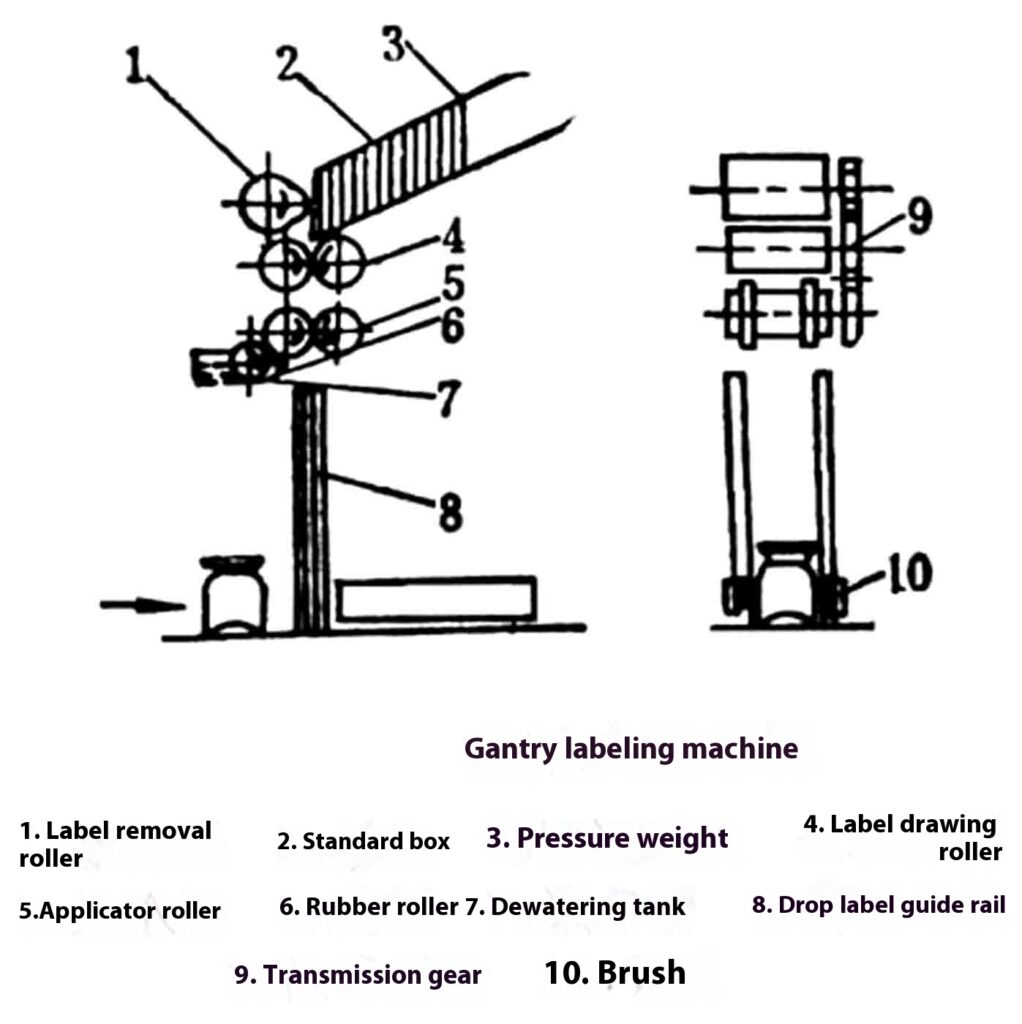
This labeling machine is only suitable for applying labels with a width approximately equal to half the circumference of the bottle. It is not suitable for labels that are too wide or too narrow and can only be used on cylindrical bottles. Its production capacity is approximately 1,500 to 1,800 bottles per hour, making it suitable for small and medium-sized food processing plants.
Rotary Fork Labeling Machine
As shown in the figure, the rotating fork 7 rotates intermittently. When it is in the correct position, as shown in the figure, it is coated with adhesive in the adhesive tank 2 by the adhesive roller 6, the roller 5, and the coating roller 3. When the rotating fork is rotated to the upper position, a label is retrieved from the label tray 4. When the fork rotates to the lower position, the bottle pusher mechanism 1 pushes the bottle through the fork and then applies the label to the bottle using the brush.
Vacuum Label Suction and Pressure Labeling Machine
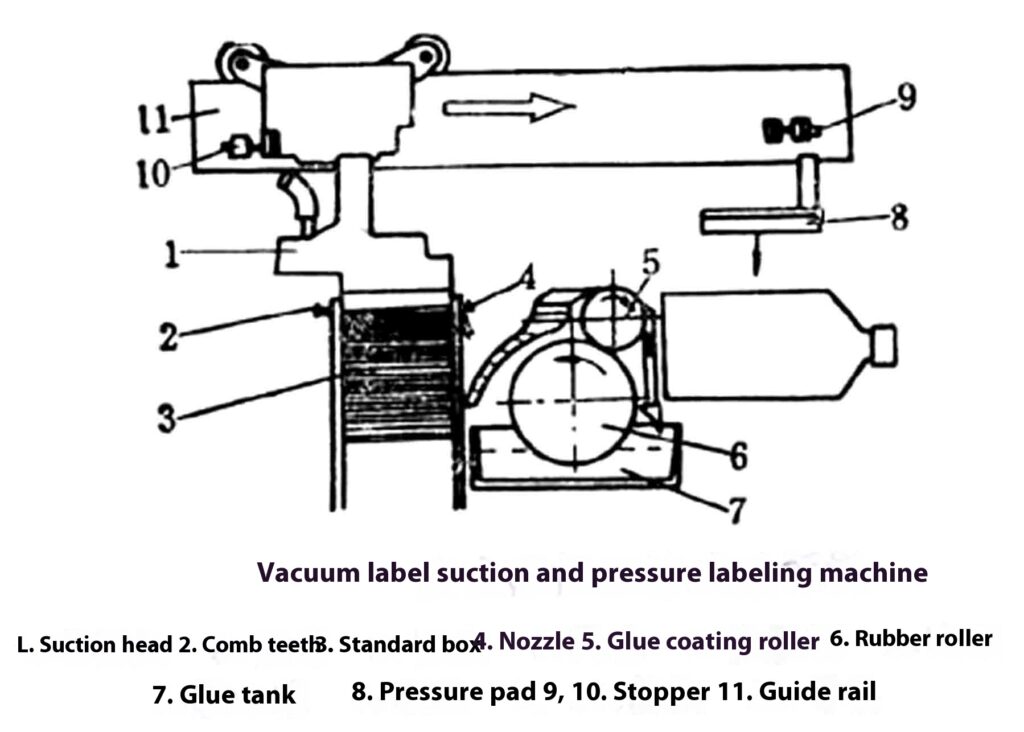
See the illustration, which consists of a vacuum label suction head 1, a label tray 3, an adhesive roller 5 and an adhesive roller 6, a pressure plate 8, and a guide rail 11. The label suction head moves left and right along the guide rail and is limited by buffer blocks 9 and 10. When the suction probe is in the left-hand end position, the vacuum is activated and a label is drawn from the label tray by vacuum suction. To ensure that only one label is picked up at a time, a nozzle 4 and a comb 2 are mounted on the top of the label tray. After picking up the label, the label suction head moves to the right, and during this movement, glue rollers 6 and 5 apply glue to the label. When the suction head contacts block 9, it stops moving and lowers to transport the label to the bottle. The vacuum is released, the label is affixed to the bottle, the label suction head returns, and then the pressure plate 8 lowers, with the rubber pressure plate pressing the label onto the bottle. The labeling machine has a production capacity of 2,400 bottles per hour and is highly customizable.
Rotary Labeling Machine
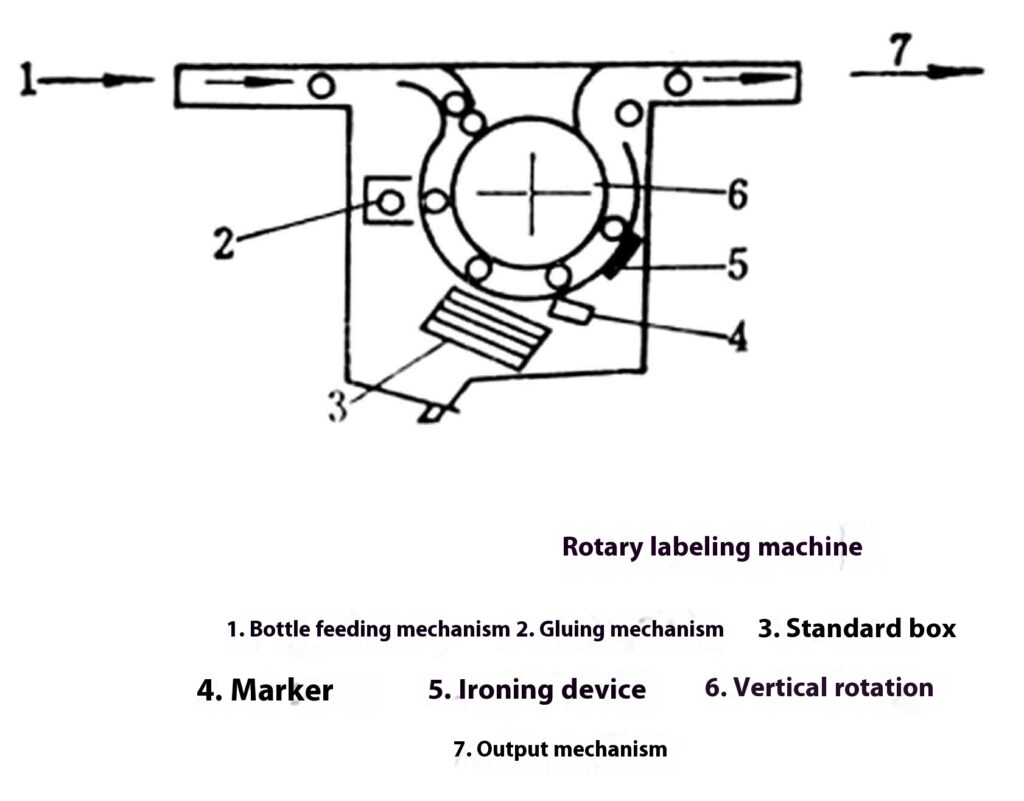
It consists of a bottle feeding mechanism, a vertical turntable, a gluing mechanism, a label dispenser, and a fuser, as shown in the figure. When it rotates to a specific position, it completes the gluing, labeling, and capping processes, respectively, and is then sent out via the conveyor belt.
Vacuum Drum Labeling Machine
Operating process: Bottles and cans are conveyed by the plate conveyor belt 1, and then the bottles, arranged in rows, are spaced apart at a specific interval and fed to the vacuum drum 3 by the bottle feeding screw 2. When the bottles pass through the bottle feeding screw 2, the “no bottle, no label” sensor is triggered, and the circuit is disconnected. At this time, the label box 6 performs a combined swinging and moving motion to remove the labels. The vacuum drum 3 rotates counterclockwise, and there are six labeling sections on the cylindrical surface of the drum.
Each section has a group of vacuum holes used to remove labels. The vacuum is engaged and disengaged by the movement of the slide valve in the vacuum drum. When a bottle is fed into the system, the label box 6 approaches the drum, and the roller on the label box bracket contacts the flap of the vacuum drum’s slide valve. This connects the vacuum drum to the corresponding vacuum port at the position of the label box, and a label is drawn from the attached label box 6. The label box then moves away from the drum, and the label section passes through the code printing device 5 and the adhesive coating device 4, where the manufacturing date and the correct amount of adhesive are printed, respectively. The drum continues to rotate, and the adhesive-coated label comes into contact with the bottle being fed by the bottle feed screw 2. Therefore, the speed of the bottle feed screw must be precisely matched to the rotational speed of the drum so that the bottle and the drum’s labeling station align accurately. At this point, the valve in the drum switches the label’s vacuum suction port from a vacuum connection to a direct connection to atmospheric pressure. The label loses the vacuum suction force, detaches from the vacuum drum, and adheres to the bottle. When the bottle and the label come into contact, the bottle becomes wedged between the rubber portion of the drum and the sponge rubber 8. Driven by the friction of the drum, the bottle begins to rotate around its own axis, and the label is rolled onto the bottle.
The labeled bottle is conveyed further along the plate conveyor and enters the channel formed by the friction conveyor 7 and the second sponge rubber pad. The bottle is pushed forward, and the label is rolled up more flatly and tightly.
Shrink-wrapping machine
So-called shrink wrap (also known as heat-shrink film or heat-shrink packaging) involves the use of shrink wrap as a packaging material to wrap items. The package is then quickly passed through a box-shaped heating chamber (or shrink tunnel) at a specific high temperature. Due to the rapid heat treatment, the packaging film automatically shrinks by a certain amount and fits snugly around the packaged item for easy transport or sale.
It is clear that the performance of plastic film plays a decisive role in shrink packaging. Standard plastic film is usually produced through extrusion, calendering, and solvent casting. Shrink film is a film (or tubular film) that is manufactured in this way and then stretched multiple times in the longitudinal or transverse direction, causing the molecular chain or the specific crystal plane of the film to be oriented parallel to the film surface, which increases the film’s strength and transparency. At the same time, at a certain temperature during stretching, the film’s stretch ratio before solidification increases to 1:4 to 1:7 (the stretch ratio of standard film is 1:2), enabling the film to deliver the required shrink performance during packaging.
Shrink films are broadly divided into two categories based on their production method and area of application: one is where the film’s elongation in the longitudinal and transverse directions is virtually the same during processing, which is called a biaxially oriented shrink film. The other is where the film is stretched in only one direction during production, which is called a uniaxial stretch-shrink film.
Biaxial films have a very wide range of applications and can be used for packaging fresh foods or food trays, etc. Uniaxial film is often used for shrink packaging and tube-film label packaging, such as label packaging for wine barrels, sealed packaging with caps for plastic and glass bottles, and sleeve packaging for fresh fruits and vegetables.
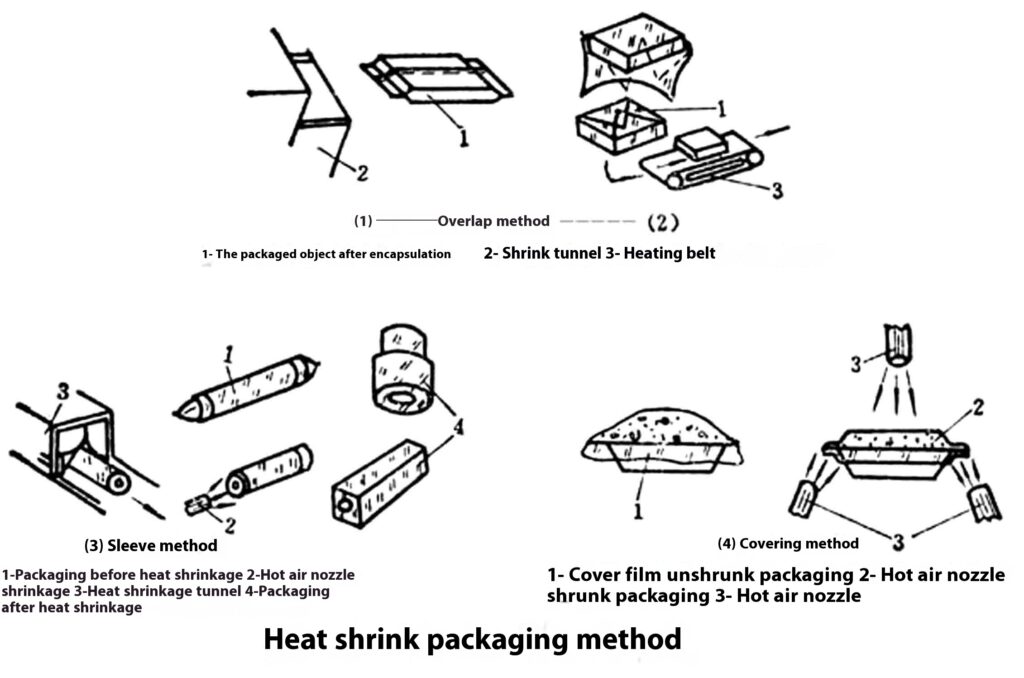
There are three methods of shrink wrapping: (1) the overlap shrink wrapping method; (2) the sleeve shrink wrapping method; (3) the lid shrink wrapping method.
There are two methods for heating shrink wrap: using a shrink tunnel and using a heat gun.
Shrink Wrap Packaging Method
(1) Overlap method. As shown in Figures (1) and (2), the packaged object is placed in a shrink-wrap bag 1, sealed, and shrunk through a heating channel 2; or, as shown in Figure (2), the packaged object is covered with shrink film, folded from the four corners toward the bottom of the packaged object into a shape 1, and then shrunk on a heated conveyor belt 3.
(2) Sleeve method. Wrap cylindrical or rectangular food items in tubular shrink wrap, roll the wrap up to about 20 mm, and leave a margin of 30–50 mm along the length. First, heat the two ends and pull them tight, then shrink the entire package, as shown in Figure (3).
(3) Sealing method. This method is used for packaging containers with edges. It involves heating and shrinking the bottom edge of the container or tray, as shown in Figure (4).
Heat Shrink Tubing Heating Method
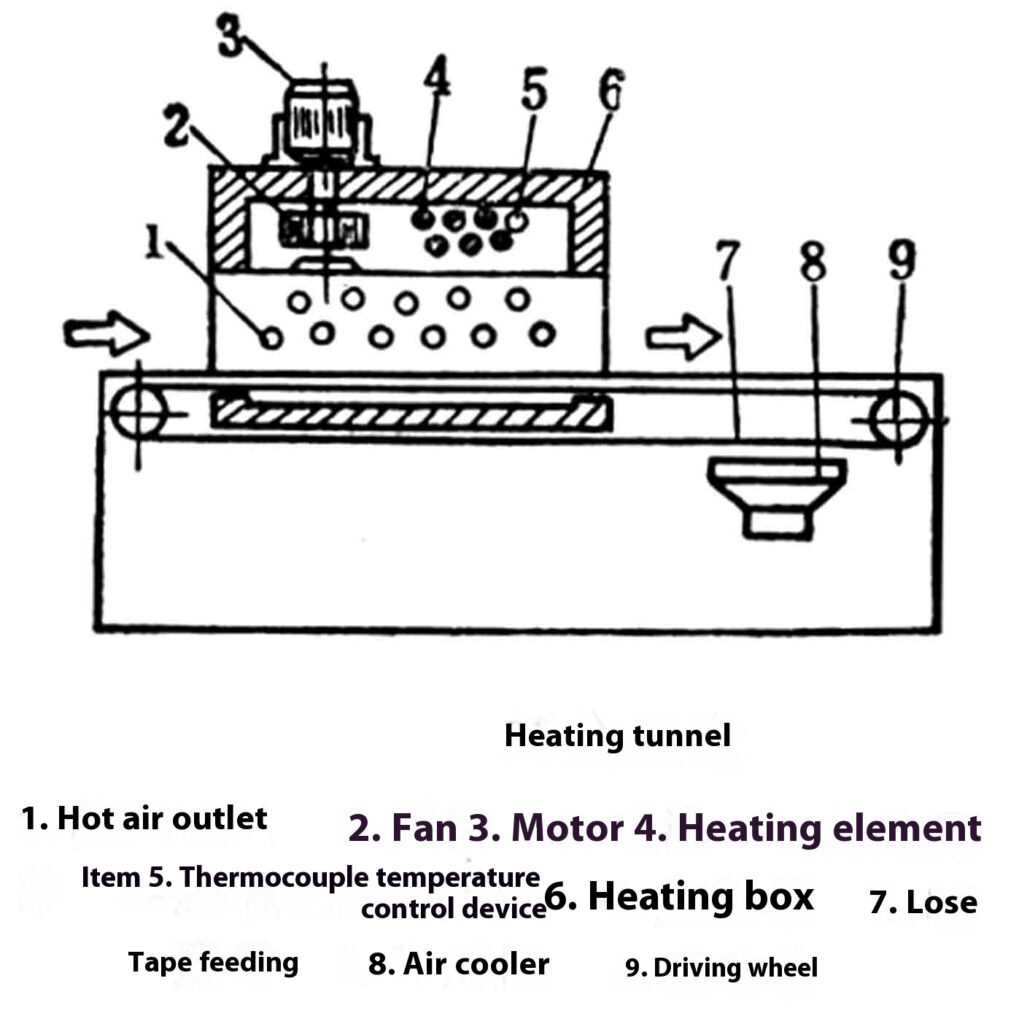
(1) Shrink-wrap channel heating. See the illustration. This consists of a heating chamber 6, lined with insulation material, a conveyor belt 7, a drive wheel 9, and a cold-air blower 8. There is no heating element 4 in the heating chamber. Hot air circulation is achieved by fan 2 and the temperature controller 5. The packaging is fed in via the conveyor belt and heated as it passes through the tunnel. To heat the packaging film evenly, an electric fan is used to circulate the air. The temperature inside the box is stabilized by the temperature controller (the temperature difference is a maximum of ±5 degrees). After heating and shrinking, the packaging is cooled by the cold-air blower.
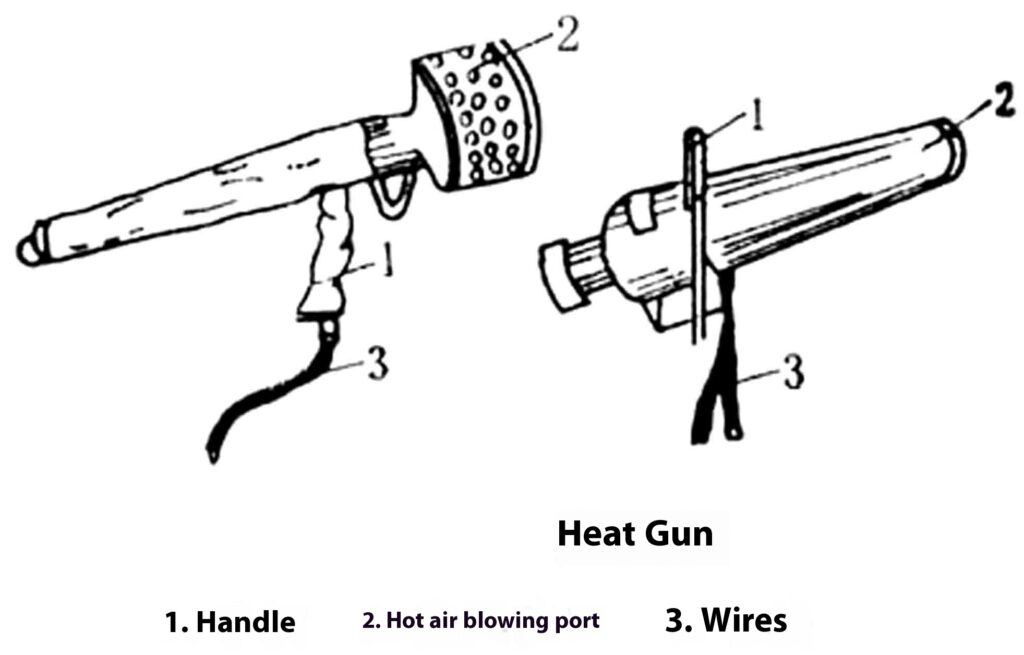
(2) Manual heating with a heat gun. For small batches of shrink-wrapped products where it is not practical to build a separate heating channel, a heat gun can be used for manual heating. The structure of the heat gun is shown in the figure above.
Medium-sized four-sided shrink-wrapping machine
For packages with a width of 200–500 mm and a length of 250–1,500 mm, a medium-sized four-side sealing machine, such as the one shown in the figure, can be used.
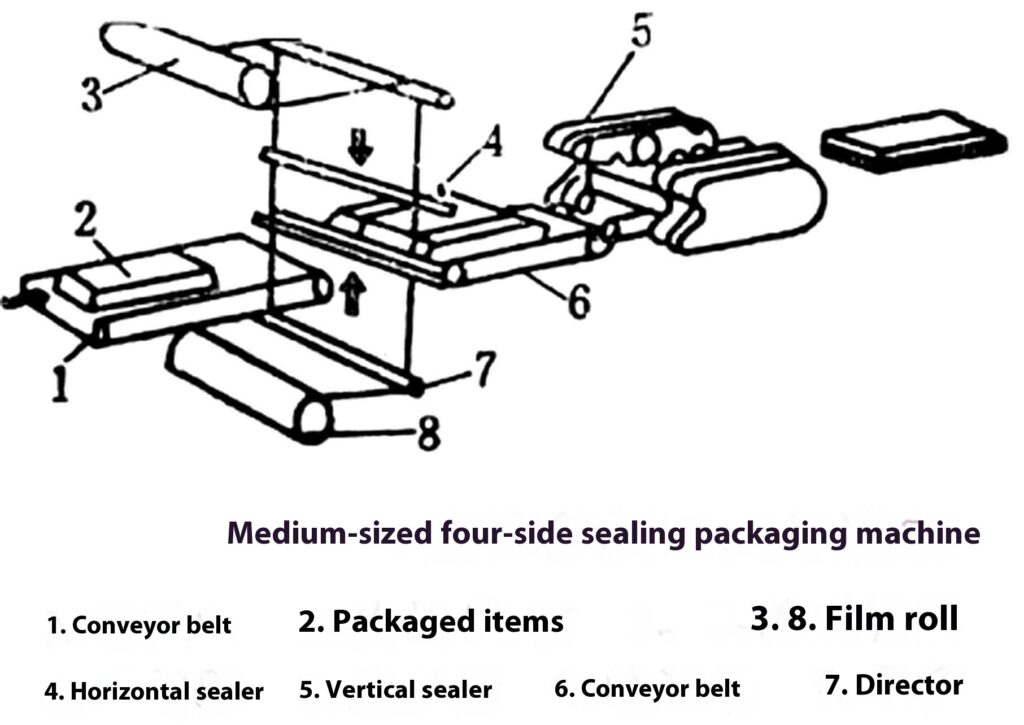
The upper and lower rolls of film 3 and 8 are guided by the guide roller 7 to the cross-sealing machine 4 for heat sealing. The material 2 is fed by the conveyor belt 1. After it has been moved against the film to a predetermined length, the cross-sealing machine is activated to complete the cross-seal of the front and back packages and cut them off (it can also simply complete the cross seal and cut them off after the longitudinal seal). Next, the belt-type longitudinal sealing machine 5 completes the two side seals and then feeds them for heating and shrinking.
External Packaging Machines
During the process of mechanizing packaging in the food industry, the mechanization of food packaging and inner packaging developed earlier and gradually formed a complete production line integrated with the processing machinery from the previous stage. Outer packaging machines have evolved in modern times to meet the urgent needs of industrial production. The mechanization of outer packaging can not only reduce labor intensity but also significantly improve labor efficiency.
Outer packaging operations generally involve four aspects: preparing outer packaging boxes (for example, opening and forming stacked, folded flat boxes); filling containers with food; closing boxes; and bundling, along with four other processes. The machines that perform these four operations are called box-forming machines, cartoning machines, box-sealing machines, and bundling machines (or strapping machines). In modern times, as these individual machines are constantly being improved and developed, fully automatic packaging lines have emerged that combine the sorting, packaging, and bundling of packaged food—that is, the collection of small pieces of food into boxes—so that closing and bundling form a single step.
Since packaging materials include cans, bottles, bags, boxes, cups, etc., and their shapes and materials vary, there are many different types and models of machines for packaging outer packaging. However, since the packaging processes involve no more than the four aspects mentioned above, the operating principles and procedures of many similar machines are comparable.
Box Packaging Machine
A case-packing machine typically packs cans, bottles, bags, boxes, etc., containing packaged products into corrugated cardboard boxes. The packaging method varies depending on the shape and requirements of the product. For example, products in bottles are generally packed upright and, after being pushed together, placed in the channel to assume the desired position. They are then pushed into the box vertically, either from top to bottom or from bottom to top.
Canned products can be packaged in a similar way to the bottles mentioned above. Canned products can also be rolled horizontally through the distributor. The resulting arrangement is precisely aligned with the position of the box’s opening side. The cans, lying flat and neatly arranged, are slid horizontally into the box. For a box with an opening on one side, the cans are slid or placed vertically into the box.
The packaging machine for packaged dairy products is also a specialized type of machine. This type of packaging machine uses a gripper to pick up the carton vertically, stacks the cartons vertically in a specific order, and then pushes the package to the desired position at a predetermined time using a machine.
There are many types of cartoning machines, which can be broadly divided into three categories:
(1) Cartoning machine for corrugated cardboard boxes. The flat corrugated cardboard boxes are stacked on the rack and folded. Each time a sheet is fed, it is formed into a box, filled with the packaged food, and then sealed. The food is loaded into the box either manually or automatically.
(2) Machine for packaging corrugated cardboard boxes. The corrugated cardboard box is formed in the same way as the first type. During transport, the box feeder is synchronized with the conveyor belt that feeds the packaged food, and the food is loaded and then sealed.
(3) Machine for packaging corrugated cardboard boxes. This machine stacks individual sheets of corrugated cardboard with fold lines one by one onto the rack, pushes the packaged food onto a specific section of the cardboard, and then forms the box along the cardboard’s fold lines and glues it shut. After the box is sealed, it is removed from the machine to complete the process. This is generally referred to as the push-wrapping method.
The purpose of packaging is to prevent food from being damaged during transport, to ensure it is delivered intact to the retailer, and to make unpacking it for sale as easy as possible. That is why packaging technology must be continuously improved.
Depending on the process involved in packaging, a distinction can be made between: folding packaging machines; compression packaging machines; and drop-wrapping machines.
sealing machine
The sealing machine is a pneumatic, automatic sealing device. It is used for sealing and labeling boxes containing canned food or other packaged food.
The machine's structure: consists primarily of rollers, lifting sleeve cylinders, stepped conveyor belts, folding tongs, upper and lower paper rack assemblies, upper and lower water cylinders, pressure rollers, upper and lower paper cutters, pneumatic systems, etc.
The machine’s main operating process is as follows: the open box filled with canned food, bags, boxes, and other packaged food products is immediately flipped over by the box support plate of the box packaging machine onto the machine’s roller. The operator of the case packer then gives it a push, causing the case to slide forward along the inclined roller and hit the limit switch. At this point, the lifting cylinder at the bottom of the roller begins to rise under the influence of the pneumatic system, and the box is transported by the step conveyor to the top of the ring beam. As soon as the box is in place, the signal is connected, the action command is given, and the step conveyor begins to move.
The step-type conveying mechanism is driven by the cylinder to move two push rods back and forth. Each time a carton arrives, the mechanism moves once, and the carton is gradually pushed from this process to the next by the push claws on the push rod. The open carton is pushed into the arched frame by the push claw of the step-type conveyor. First, the small folding tongue at the rear of the box is swung by the folding hook, and the folding tongue at the front of the carton is closed by the fixed folding device during the pushing process. After that, the large folding flap of the box is closed by the folding plates on both sides and pressed flat by the baffle at the rear. The carton is pushed under the pressure roller and conveyed to the next sealing process. The paper tape used as the seal is loaded onto the upper paper tray. After the paper tape is fed out through the bracket, it is moistened by the water coating device, then guided to the top of the carton (the bottom of the carton also has the same sealing device), and pressed onto the box by the upper pressure roller. As the box is transported forward by the conveyor’s push claw, the paper tape is gradually applied to the box from front to back. The push claw of the step-type conveyor then pushes the carton forward to the paper-cutting section. After the box comes to a stop, the cutter moves downward (the lower cutter moves upward) to cut the paper tape. The rollers installed on both sides of the cutter then roll the paper strips from the rear end of the previous box and the front end of the next box onto the box, so that the upper and lower seals form a “door” and ”U” shape to seal the box. The sealed carton is then transported to the next process by the push claw. If a self-adhesive seal is used, the water coating device can be omitted.
Automatic box-sealing machines are generally used in manufacturing to improve production efficiency.
Strapping Machine
A strapping machine is a machine used to strap various boxes or packaged items of different sizes using various ropes and straps. Strapping machines have evolved rapidly, with a wide variety of types and styles. The main classification methods for machine types are: A. Based on the machine’s level of automation, it is divided into automatic strapping machines and semi-automatic strapping machines; B. Based on the method of feeding the strapping band, they are divided into penetration-type strapping machines and wrap-around strapping machines; C. Based on the material of the strapping band, they are divided into paper strapping machines and automatic strapping machines.
Conclusion
The use of labeling, shrink-wrapping, sealing, and strapping machines in the packaging industry significantly improves the speed, accuracy, and efficiency of packaging processes. Whether it involves applying precise labels to containers, applying shrink wrap to products of the correct size, securely sealing boxes, or strapping them for transport, these machines work together to ensure that products are packaged safely and professionally. As automation continues to advance, packaging machines will play an increasingly important role in optimizing production lines and meeting the growing demand for high-quality packaging solutions across all sectors.






 English
  Dutch
Dutch