Implementation
Heat sealing is an essential process in the packaging industry, used to join plastic films using heat and pressure. Different heat sealing methods offer specific advantages depending on the type of material and the specific packaging requirements. Whether you’re sealing polyethylene films, composite materials, or specialized films for sensitive products, selecting the right heat sealing method can ensure strong, durable seals that maintain product integrity. This guide explores the most common heat sealing methods, including plate, roller, pulse, and ultrasonic sealing, along with their applications and benefits in packaging.
Depending on the various heating and pressure methods, the heat fusion methods used by heat fusion machines can be classified into the following types.
Plate Heat Seal
Plate welding is the most common welding method. In this process, a heating plate is used to heat the plastic film intermittently and apply pressure to seal the film. The principle of sealing is illustrated in Figure 6-2. The two film layers 3 to be sealed are transported between the heating plate 1 and the workbench 5 and then pressed firmly against the non-stick material 4. The heating plate 1 and workbench 5, which have been heated to a specific temperature (constant temperature control), are heated and pressurized and then cooled to achieve a good seal.
Commonly used non-stick materials include heat-resistant polytetrafluoroethylene or glass cloth, primarily to prevent the T-table from sticking to the film layer, ensuring that the bag opening is perfectly sealed and the workbench remains clean. The electric heating wire 2, installed in the heating plate 1, heats the plate. The heating temperature is typically measured by a resistance temperature detector and displayed on a temperature display. The temperature is set using a voltage regulator or resistor. To ensure high-quality seal seams, the surface of the heating plate to be sealed must be flat, and the support surface must be flat or lined with a heat-resistant rubber pad. The pressure mechanism of heating plate 1 can be pneumatic, hydraulic, cam-driven, electromagnetic, etc.
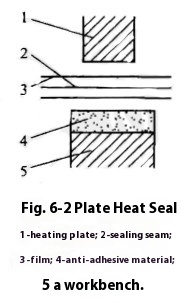
This hot-melt welding machine, which features a lamellar design, has a simple structure and operating principle, and offers high welding speed. It is widely used in intermittent automatic packaging machines. It is primarily used for heat-sealing polyethylene films and polyethylene composite films, but not for heat-sealing films that shrink easily or degrade when exposed to heat.
Roll of heat seal
In roller heat sealing, the plastic film is sealed by applying pressure with a continuously rotating roller and heating it with one or two rollers in a roller pair.
The principle of roll sealing is illustrated in Figure 6-3. When the two layers of film 2 to be sealed are pulled through a pair of heating rollers 1 (or just a single heating roller), they are heated and pressed together, and then cooled to achieve a good seal. The resistance heater is housed within the heating roller, and current is conducted to the heating wire via wiring (such as brushes, slip rings, and wires) that is insulated from the machine. The temperature control device and the device and instrument for detecting and displaying the temperature of the heat-sealing roller are located on the outside.
Roll sealing is characterized by continuous sealing, which is suitable for sealing composite films consisting of a base film (cellophane) and a seal film (polyethylene). In some continuous, multi-function automatic packaging machines—such as those used for forming, filling, and sealing bags—the sealing roller can not only complete the longitudinal seal of the packaging film but also serve as a conveyor belt for pulling and transporting the product. Some films can easily warp due to heat, which affects the seal quality and therefore makes them unsuitable for use.
Heat-sealing tape
As shown in Figure 6-4, the two layers of film 2 are placed between a pair of thin round belts 1 (such as a polytetraethylene belt, steel belt, stainless steel belt, or nylon textile belt) that rotate in opposite directions. These are heated on the heating elements 4 on both sides of the ring belts, so that the two layers of film are bonded together between the ring belts. The layers are then cold-pressed on the cooling element 5 to seal the film 2. Before the seal is fully formed, it is embossed by a pair of embossing wheels at a preset pressure. Next, the production date is printed using the print code wheel, and the seal is complete.
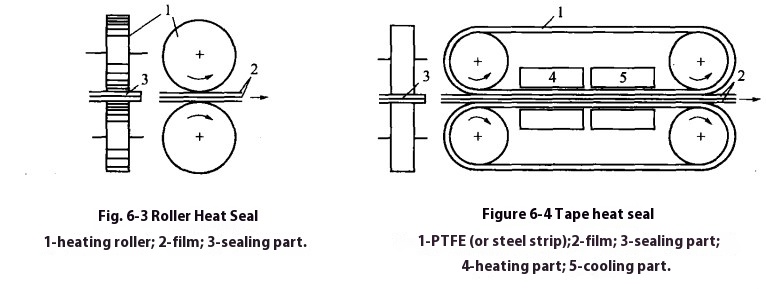
This method is suitable for heat-sealing composite films. Even films that are easily deformable can be continuously sealed with this machine. The sealing speed is relatively high, making the machine highly versatile.
Sliding-type thermal seal
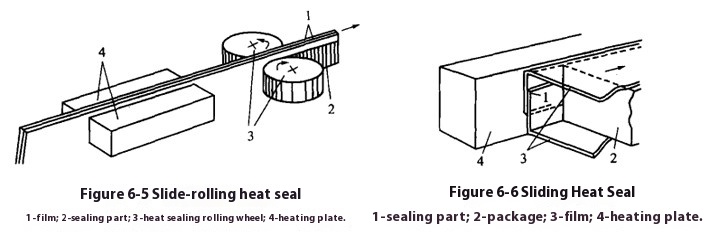
As shown in Figure 6-5, the two overlapping layers of film 1 are fed between a pair of heating plates 4 to be heated to a soft, molten state. As they pass between the closely spaced rollers 3, they are compressed and sealed. A key feature of this type of sealing device is that the resistance heater and the roller are each independent components, which simplifies the roller’s design. The overall structure is simple and has a wide range of applications.
This method can be used for the continuous heat sealing of film packaging materials, as well as for the continuous heat sealing of films that are prone to significant thermal deformation. If the machine stops unexpectedly, the film material between the electric heating plates will overheat and be ruined. The heater must therefore be able to automatically vent to prevent the film from overheating.
Sliding thermal seal
Slide sealing is used for wrapping packages, as shown in Figure 6-6. In this process, a film 3 is used to wrap the packaged object 2 so that it slides over the heating plate 4. The slight pressure from the packaged object and the heat from the heating plate 4 cause the overlapping sections of the two layers of film to bond together.
Pulse Heat Seal
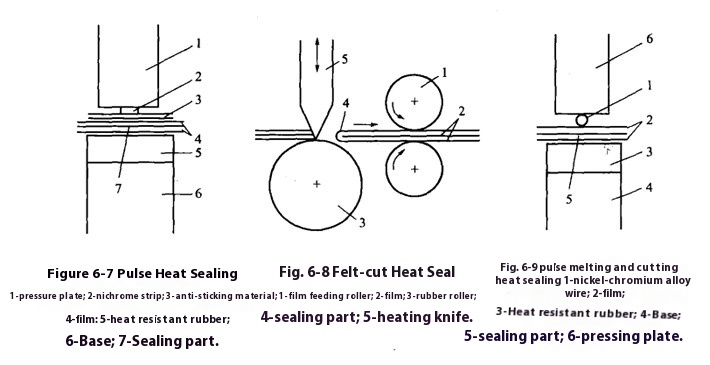
As shown in Figures 6–7, the nickel-chromium alloy strip 2 presses the film 4 onto the heat-resistant rubber 5. The nickel-chromium alloy strip 2 is heated directly by a high current, and the heat is used for heat sealing. A key feature is that the alloy strip 2 leaves the heat-sealing area only after it has cooled, allowing even films that are prone to deformation to be sealed using this method. This method is suitable for sealing products with high requirements for seal strength and sealability, such as liquid packaging and vacuum packaging. This method is generally suitable for intermittent sealing and is widely used in bagging machines or automatic packaging machines.
Hot-Cut Heat Seal
As shown in Figures 6–8, the heating blade 5 (or steel wire) is used to melt and cut the film 2 while simultaneously sealing it. This sealing mechanism has a simple structure, a high sealing speed, and can melt, cut, and seal the film simultaneously. However, due to the narrow weld seam, the seal strength is relatively low, and the package is easy to open. It is only suitable for inner packaging of small quantities of fine powders and granules.
Pulse-Melt Heat Welding
Melting the heat seal requires frequent heating of the blade and the steel wire, whereas pulse cutting does the opposite, as shown in Figures 6–9. When the pressure plate 6 drives the cast alloy wire 1 to press the film 2 onto the heat-resistant rubber 3, the nickel-chromium alloy wire 1 is immediately activated and continues to press down on the heated and molten sealing section until it is released after cooling. This method can also simultaneously complete the melting and sealing of the film.
Fusion Welding
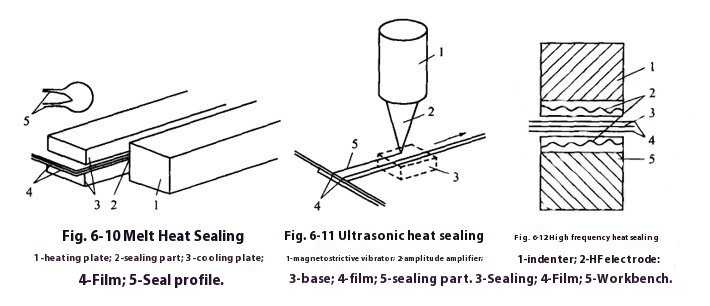
As shown in Figure 6-10, the heating plate 1 or the flame must be positioned close to one end of the overlapping film 4 to melt and bond it. This method can provide the shrinkable biaxially oriented polypropylene film with high weld strength.
Ultrasonic Heat Welding
As shown in Figure 6-11, this hot-welding mechanism consists of a high-frequency oscillator, a magnetostrictive vibrator 1 that converts high-frequency electrical energy into longitudinal vibrations, and an exponential amplitude amplifier 2 that transmits the longitudinal vibrations to the film. During heat welding, the ultrasonic vibration emitted by the exponential amplitude amplifier causes the overlapping surface of the film 4 to heat up, melt, and bond.
This sealing method is characterized by heat generation at the center of the film overlap, making it suitable for the continuous sealing of films that shrink easily when heated, such as biaxially oriented films. It can heat-seal various plastic films (such as polypropylene, nylon, aluminum-plastic composites, polyoxyethylene cans, etc.) and can produce a good seal even if the packaging material is accidentally contaminated with water, oil, etc., during filling. It also provides high-quality sealing for plastics that are susceptible to shrinkage or thermal decomposition. It is particularly suitable for heat sealing in the packaging of food, medicines, radios, and electronic components that are sensitive to thermal radiation, and is widely used in bagging machines or automatic packaging machines.
High-Frequency Heat Sealing
As shown in Figure 6-12, high-frequency heat sealing involves pressing the film 4 against a high-frequency electrode 2, applying a high-frequency voltage, and sealing the film through the dielectric loss of the polymer. The temperature of the seal area is highest at the seal surface, which prevents the film from overheating and ensures high seal strength.
The sealing time of the heat press sealer depends on the heating temperature, the heating method, the film material, the thickness of the film material, and the sealing pressure. For film materials of the same type and thickness, the following applies: at a constant sealing pressure, the higher the heating temperature, the shorter the sealing time. The heating temperature, pressure, time, and other sealing parameters must be determined experimentally based on the mechanical and physical properties of the material being sealed.
Conclusion
A heat-sealing machine is a machine that seals packaging using heat. This machine is widely used for heat-sealing various types of plastic bags. Understanding the different heat-sealing methods—from the simplicity of plate sealing to the advanced capabilities of ultrasonic sealing—enables manufacturers to select the most efficient and suitable solution for their packaging needs. Each sealing method offers specific advantages based on the desired materials, production speed, and quality. By choosing the right technique, companies can improve packaging efficiency, reduce waste, and ensure high-quality seals that meet industry standards.






 English
  Dutch
Dutch