Packaging plays a crucial role in ensuring the safety, quality, and shelf life of products, particularly in the food and pharmaceutical industries. Various types of packaging pouches, such as pillow-shaped pouches, flat pouches, and stand-up pouches, are widely used. Each offers its own advantages in terms of seal quality, aesthetics, and suitability for specific product types. Among the many methods, vacuum packaging stands out for its ability to extend product shelf life by slowing oxidation, inhibiting microbial growth, and making storage more efficient. Vacuum packaging machines, particularly single- or double-chamber machines, are essential for automating the vacuuming, sealing, and inflating processes, thereby ensuring product integrity and improving overall packaging efficiency.
Types of Packaging Bags
Common plastic film bags are available in the following shapes:
Pillow-shaped bag. The standard sewing method involves overlapping the long seam and then closing the two ends, as shown in Figure (1).
Flat bag. This can be divided into a three-sided sealed bag (see Figure 2) and a four-sided sealed bag (see Figure 3).
Standing bag. Common designs include the bag with pointed corners (Figure 4), the triangular bag (Figure 5), and the cube-shaped bag (Figure 6).
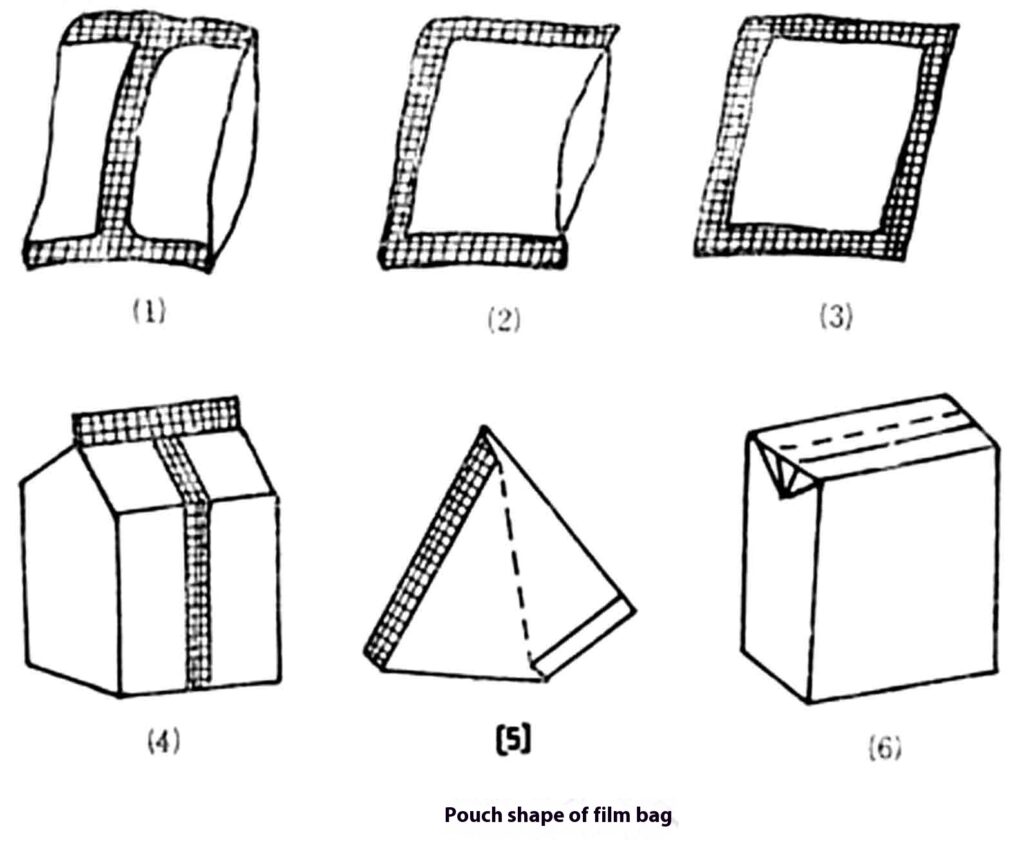
When manufacturing bags, the bag is generally sealed first lengthwise and then horizontally. As a result, three or four layers of film overlap along the entire length of the overlapping and butt-jointed seal seams of the pillow-shaped bag at the sealing area, which has a certain impact on seal quality. The number of film layers along the entire length of the seal seam of the flat, three-sided sealed bag is uniform, and the seal quality is better; however, the shape of the bag is asymmetrical, and its appearance is slightly less appealing. Four-side sealing overcomes the shortcomings of the two situations mentioned above, but it uses more packaging materials and is often used for simple sealing machines for small packages. Various stand-up pouches have an attractive appearance and the advantage of being self-supporting, which is convenient for the subsequent packaging process as well as for product placement and presentation. However, they place high demands on the packaging materials, and composite packaging materials must be used.
Vacuum Packaging Machine
Vacuum packaging involves placing food in a package, removing the air, achieving a specific vacuum, and then sealing and packaging it. This is a new packaging method that has developed rapidly in recent years in the food and pharmaceutical industries, both domestically and internationally. It has the following characteristics:
(1) Slow down oxidation and spoilage, inhibit microbial reproduction, and thereby extend the shelf life of food. Food is exposed to a certain number of microorganisms that multiply in the air and cause food to spoil. Once the air has been removed, microorganisms slow their reproduction in the absence of oxygen, and many easily oxidizable substances also oxidize more slowly due to the lack of oxygen.
(2) It is suitable for thermal sterilization. If there is a lot of air in the container with food, heat conduction is poor, it takes a long time to heat the food, and the sterilization time is extended; after the air is removed, the food quickly reaches the required temperature. In addition, removing air can also prevent the container from cracking due to gas expansion during the heating and sterilization process.
(3) Once the air has been removed, the volume is reduced, which is convenient for storage and transport.
(4) Because the packaged food must retain a certain amount of moisture and the packaging material also has a certain degree of air permeability, vacuum packaging cannot achieve a complete vacuum and can reach a maximum vacuum level of -0.096 to 0.099 MPa.
Design Principles of a Single-Chamber Vacuum Packaging Machine
The image shows the structure and operating principle of a medium-sized vacuum packaging machine, which is widely used in small and medium-sized food processing plants.
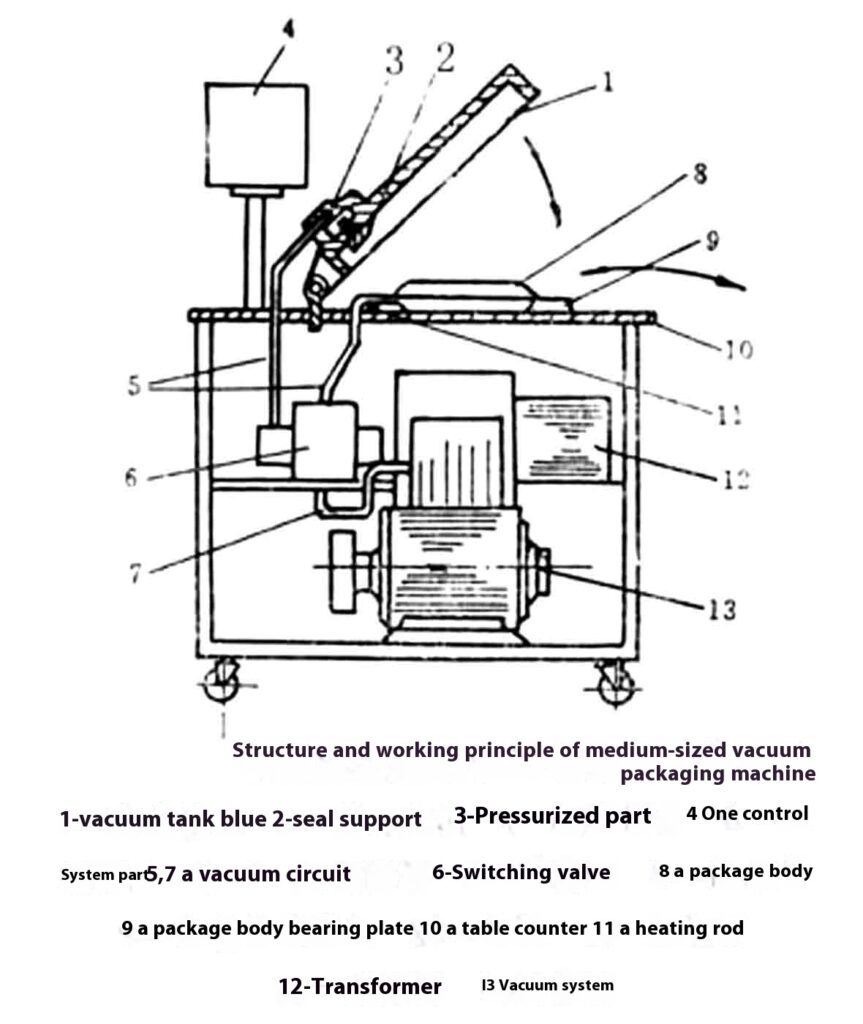
The packaging process for packaged food products is as follows: Place the package in the vacuum chamber for positioning, place the opening of the bag on the heating block, insert the vacuum nozzle into the bag’s opening, and close the vacuum chamber lid. The limit switch and relay then automatically control the vacuuming, heat pressing and sealing, cooling shutdown, automatic opening, and other processes. The vacuum level, time, sealing time, cooling time, etc., must be tested and adjusted in advance.
The operating process of the small vacuum packaging machine is the same as that of the small vacuum packaging machine, except that each step is controlled manually.
The heating method used in hot-press sealing typically employs pulse heating. The heating element is made of low-resistance wire, and the voltage is approximately 10–50 V. When a strong current passes through it, the heating element immediately generates heat and transfers it to the heating block. The bag opening is then heat-pressed and sealed. Cooling of the seal can be achieved through natural cooling or circulating cooling water to rapidly cool the bag opening and prevent the plastic film in the sealing area from overheating.
Structure of a Dual-Chamber Vacuum-Inflatable Packaging Machine
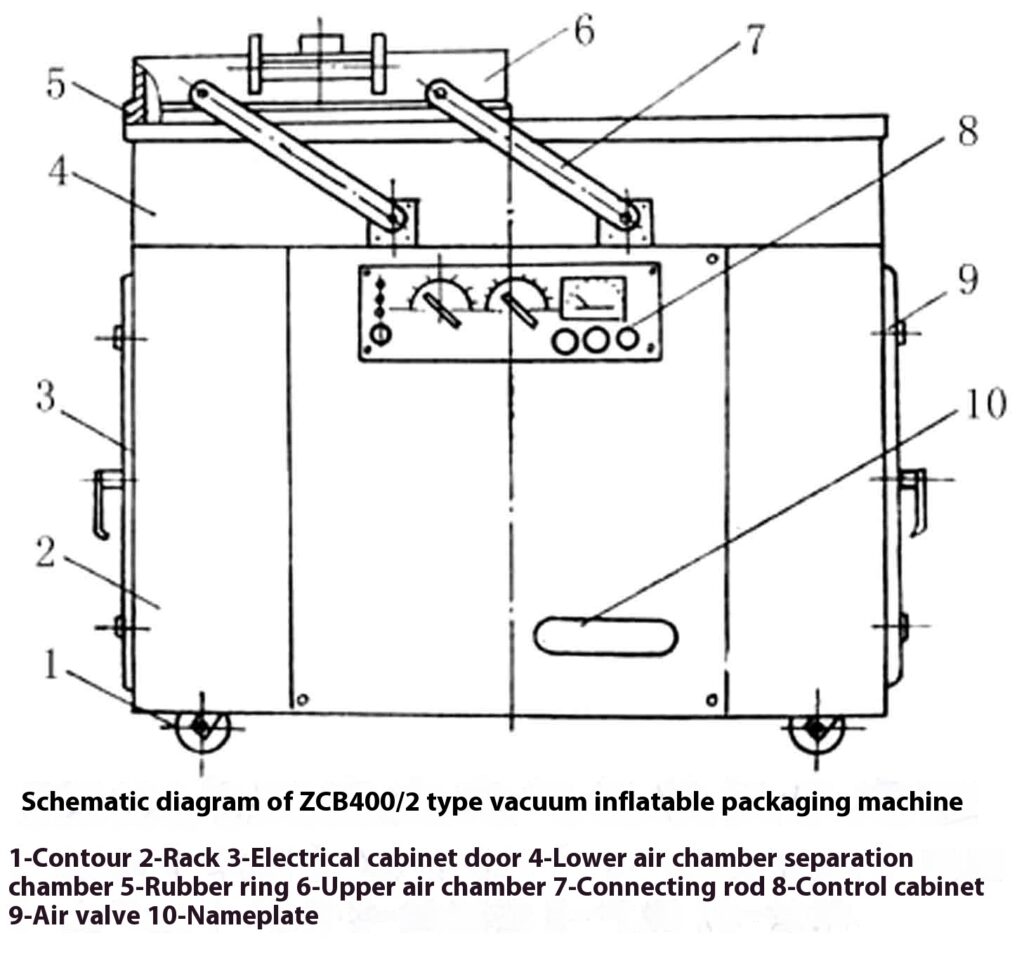
OfficeIt consists of a top cover and a base (chamber A and chamber B). The top cover and the base are sealed with a rubber gasket.
There are two small air chambers on top of the hood. The small air chambers are equipped with a heating mechanism. A vacuum gauge is installed on the outside of the hood, along with electrical heating connections, small air chamber lines, and air chamber outlets. The upper and lower hoods are connected by a four-bar linkage system to ensure smooth rotation.
Heating and Sealing MechanismThe heating head and the cover are connected at both ends by two copper plates. The two copper mounting blocks at both ends of the electric heating tape are secured with screws to prevent poor contact. The electric heating head and the end cap are fully insulated to prevent short circuits.
During operation, the small air chamber and the large air chamber are evacuated simultaneously. The heating head does not operate when the pressure difference at both ends is equal. When the air valve of the small air chamber is connected to the atmosphere to create a pressure difference, the heating head is pressed down, the seal is pressed together, and heating occurs simultaneously. The heating time and temperature can be adjusted. The heating system is a pressure-controlled type and can be used for various packaging materials. The selection button is located on the machine’s control panel. The electric heating band is made of an alloy. Heating without a load is strictly prohibited.
BaseIt is divided into two chambers, A and B, with 16 air nozzles on each side. Heating pads are located at the corresponding positions of the heating head, and below them is a cam-operated switching assembly for switching between chambers A and B.
Conclusion
Packaging bags and vacuum packaging machines are essential for the food and pharmaceutical industries, ensuring product quality and extending shelf life. Although various types of bags are available for different materials and aesthetic applications, vacuum packaging machines improve the preservation process by removing air, preventing oxidation, and facilitating thermal sterilization. The structure and operating principles of both single-chamber and double-chamber vacuum packaging machines play a key role in streamlining the packaging process, making it more efficient, reliable, and suitable for a wide range of products. Understanding these packaging methods is essential for optimizing packaging processes and ensuring proper protection of products during storage and transport.
Don't hesitate toPlease contact us If you have any questions, please feel free to contact us.





 English
  Dutch
Dutch