A bottle of ketchuppackaging machine is an automated packaging machine designed for liquid, semi-liquid, or viscous materials (e.g., ketchup, jam, shampoo) and is widely used in the food, consumer chemicals, and pharmaceutical industries. Its core functions include dosing, bag forming, filling, sealing, coding, and cutting, enabling fully automated processes. The machine supports multiple packaging formats (e.g., quad-seal, three-side seal, back-seal bags, doypack pouches) and allows for adjustment of fill volumes, bag dimensions, and packaging speeds.
Principle of Operation and Process
The machine operates via a PLC Intelligent Control System and precision mechanical components. Key steps include:
- Material Feed:The ketchup is transferred to a storage hopper by vacuum or gravity, with optional stirring to prevent settling.
- Dosing and Filling:High-precision pumps (liquid-suction, peristaltic, or ceramic pumps) provide accuracy within ±1% and can be adapted to different viscosities.
- Bag Shapes and Filling:Servo motors form packaging film into bags, which are aligned by photoelectric sensors; the material is injected using pumps.
- Sealing and Cutting: A multi-stage heat seal (with independent temperature control for horizontal and vertical seals) ensures airtightness; the cutting patterns (straight, zigzag, or continuous) vary depending on the application.
- Encoding and Output:Integrated coding systems print data and batch numbers; finished products are transported out of the facility, optionally via checkweighers or metal detectors.
Technical Specifications and Performance
Key parameters vary by model, but typical configurations are as follows:
| Parameter | Specifications |
|---|---|
| Model | LTC-480Y/720Y/960Y, LTC8-260, LTC-Y4/Y6/Y8 |
| Speed | Single-channel: 30–60 bags/min; multi-channel (4–12 lanes): up to 300 bags/min |
| Bag Dimensions | Length: 20–160 mm; Width: 25–260 mm (supports stand-up pouches, spouted bags, etc.) |
| Filling Volume | 10 ml–2,500 ml, customizable (e.g., 30–125 ml, 500–2,500 ml) |
| Strength and Energy | Voltage: 220 V/380 V; Power: 1.1–3.6 kW; Air pressure: 0.6–0.8 MPa |
| Control System | PLC + touchscreen HMI, bilingual interface, parameter storage, error diagnosis |
| Equipment & Hygiene | Stainless steel 304/316 contact parts, compliant with GMP and food safety standards |
Key Features:
- High precision:Servo motors and PID temperature control ensure consistent filling and sealing.
- Flexibility: Adjustable bag length, multi-lane configurations, and material compatibility (PE laminate, aluminum foil).
- Smart Features:Photoelectric alignment and automatic alarm systems (for temperature/pressure deviations) minimize downtime.
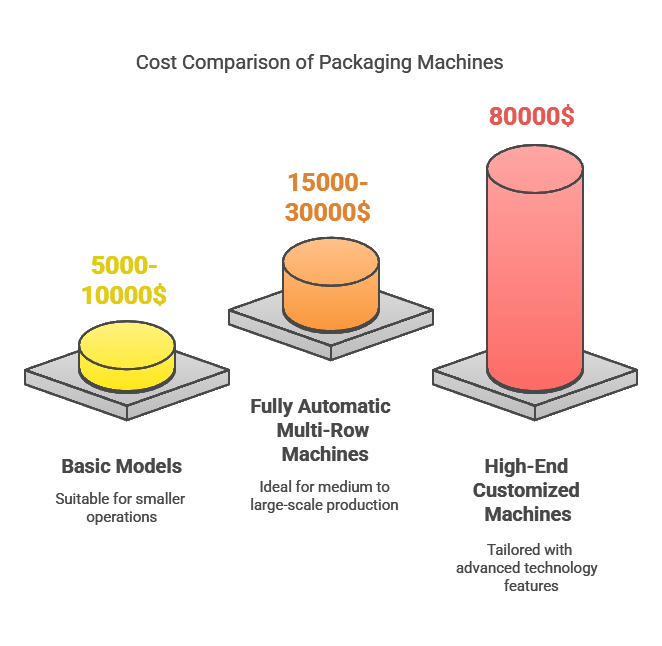
Price and Cost Factors
Prices vary considerably depending on the features:
- Basic Models: Semi-automatic single-channel machines: RMB 20,000–50,000.
- Full automation: Multi-channel models (4–8 lanes): RMB 70,000–168,000.
- High-end custom work: Aseptic/brick-type machines: RMB 200,000+.Key Cost Factors: Number of lanes, level of automation, materials, and add-ons (e.g., metal detection).
Model Comparison and Selection Guide
| Model | Benefits | Disadvantages | Applications |
|---|---|---|---|
| Single-channel retrofit seal | Cost-effective, supports irregular shapes; stainless steel construction | Lower speed (30–60 bags/min) | Small batches, various types of bags (gift packaging) |
| Multi-channel automatic | High efficiency (up to 300 bags per minute), parallel processing on multiple lanes | High initial costs, large footprint | Mass production (fast-food supply chains) |
| Vertical packaging machine | Space-saving, gravity-fed filling; ideal for small bags | Limited to high-viscosity materials | Single-use packaging (10-ml sachets) |
| Doypack machine | Spout design for ease of use; low material costs, customizable shapes | The mold needs to be modified | Premium sauces, cosmetic samples |
| Can/Bottle Filler | Extends shelf life; integrates lidding and labeling | Lower speed, complex maintenance | Family Ketchup, premium products |
| Aseptic Brick Packer | No preservatives, ultra-long shelf life; optimized for liquid ketchup | High costs, technical complexity | Export goods, need for a longer shelf life |
Selection Tips:
- Fast-food industry: Prioritize multi-channel machines because of their speed and standardization.
- Premium/Consumer Markets: Choose filling or Doypack machines for their aesthetic appeal and convenience.
- Small-scale flexibility: Choose single-channel or vertical models for a lower initial investment.
Trends and Innovations in the Industry
- Miniaturization: 5–20 ml single-use sachets for fast food/travel, to reduce waste.
- Substantial progress:Biodegradable films and aluminum laminates ensure better freshness and shelf life.
- Smart Technology: AI-powered visual inspection, IoT remote monitoring for predictive maintenance.
- Integrated lines: Seamless connectivity with filling, labeling, and palletizing systems.
By balancing production requirements, packaging formats, costs, and industry-specific requirements, companies can optimize their packaging solutions for tomato ketchup, while ongoing innovations promote efficiency, smart technology, and environmental sustainability.




 English
  Dutch
Dutch