Types of Filling and Sealing Machines
Due to the wide variety of bag shapes used for packaging items, the models and designs of filling and sealing machines also vary greatly, a fact that is particularly evident in packaging and sealing machines. There are generally two types: a machine for forming and sealing bags, and a machine for filling and sealing bags.
Machine type for forming, filling, and sealing bags
It is suitable for the production of pillowcaseken, three-side-sealed and four-side-sealed bags, flat bags, and stand-up pouches. Depending on the different bag shapes, they can be categorized as follows:
Machine for filling and sealing reverse-shaped bags
The image shows a functional schematic diagram of a vertical, intermittent reverse-fold bag-making, filling, and sealing machine used for the production of pillow-style bags. This machine can produce plastic film bags, seal them lengthwise (lap or butt seam), fill them with materials, seal them, and cut them.
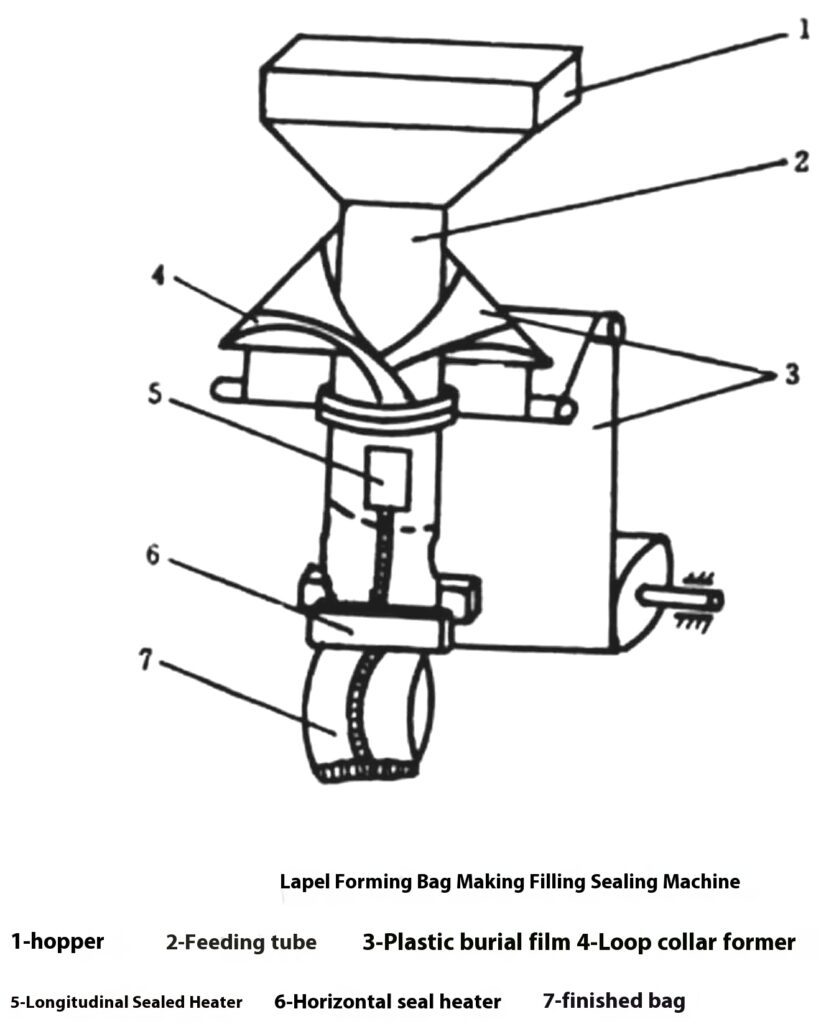
After the flat roll of film 3 has passed through several guide rollers, it enters the collar former 4, where it is first sealed and formed by the longitudinal sealing heater 5, overlapping or pressed together into a cylindrical shape. At this point, a portion of the material—measured by the dosing device—falls from the hopper 1 through the feed tube 2 into the bag. The transverse sealing heater 6 seals the bottom of the bag while pulling the bag downward, seals the previous bag filled with material, and cuts between the two bags to separate them. The finished bag 7, filled with material, is separated from the equipment. The movements of each actuator on the machine can be controlled automatically by mechanical, electrical, pneumatic, or hydraulic means.
Tower- and Cubic-Column Bag Filling and Sealing Machine
This machine is primarily used for filling and packaging liquid beverages. The packaging container can be tower-shaped or cube-shaped.
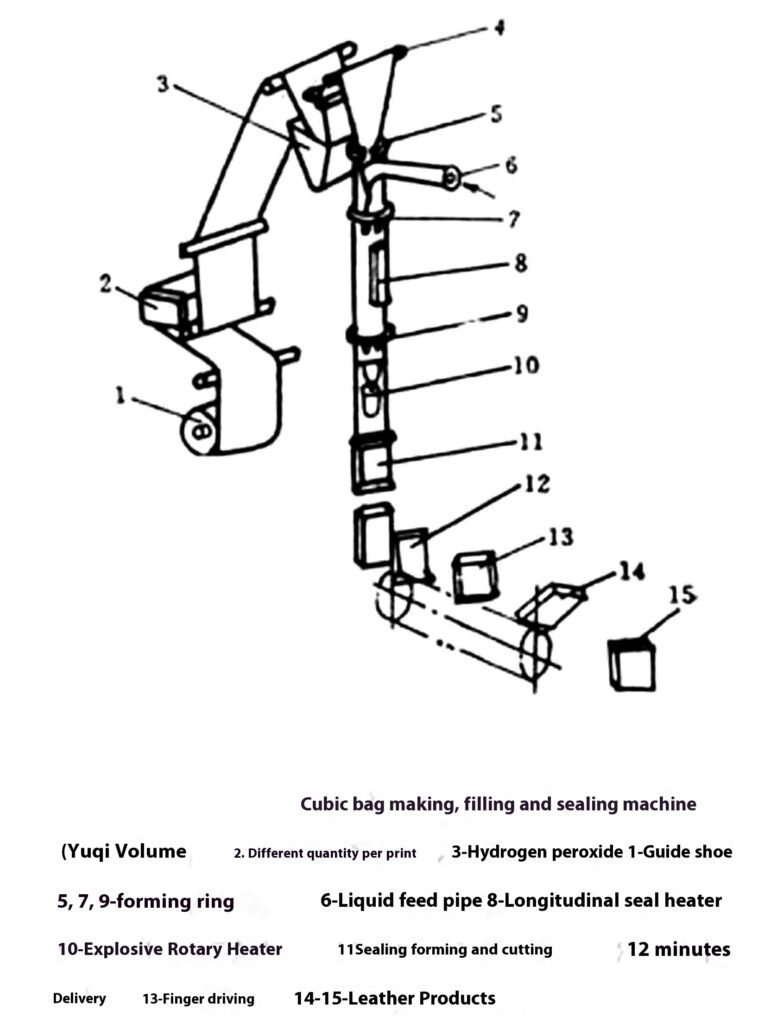
This machine is primarily used for filling and packaging liquid beverages. The packaging can be tower-shaped or cube-shaped. The illustration shows the operating principle of Tetra Pak’s cube-shaped filling and sealing machine for soft drinks. After the packaging material on the flat film roll 1 has been disinfected by the printing unit 2 (if text is already present on the packaging material, this step may be omitted) and the hydrogen peroxide disinfectant tank 3, it is guided downward by the guide roller 4 and rolled into a cylindrical shape by the forming rings 5 and 7. The seam of the packaging bag is heated by the sterile air as it moves downward, and the packaging material is pressed into a longitudinal seal by the longitudinal seal heater 8 as it passes through the final forming ring 9. The liquid material (such as juice and fresh milk) is pumped into the cylindrical packaging bag through the liquid supply line 6 by the pump, with the sterile hot air entering the cylinder from the outside of the material line and reaching the liquid surface. In addition, a spiral heater 10 is located on the liquid surface, which sterilizes the inner wall of the material and forms a layer of sterile air on the liquid surface.
Horizontal sealing and cutting take place below the liquid surface. Different configurations of the horizontal sealing mechanism produce different products, ranging from cube-shaped column packaging to tower packaging. In tower packaging, the upper and lower horizontal sealing blades are positioned at 90°. The space is staggered, and the up-and-down and opening-and-closing movements are performed sequentially to complete the horizontal sealing and cutting of the packaged items. When packaging in a cube-shaped column, the cylindrical material bag is pulled downward below the liquid surface, and the forming, sealing, and cutting are performed by the combined movement of two pairs of rectangular forming dies and the horizontal seal during the opening and closing as well as the up-and-down movements. After cutting, the semi-finished product falls onto the intermittently moving conveyor chain. While the conveyor chain is operating, finishing processes—such as folding the flaps and corners of the material bag—are completed, and the finished product is unloaded from the conveyor chain.
Flat films used for beverages such as juice and milk are usually made of composite film materials such as waxed paper, aluminum foil, and polyethylene. Before being rolled into a roll, the outer surface of the waxed paper is printed with text instructions and pattern markings. A cube-shaped carton is simply a flat composite film material, and the top of the carton features an aluminum tear-off hole for drinking; open the aluminum tear-off hole and insert a straw to sip the beverage.
Direct-transfer bag filling and sealing machine
Just fill and seal—no need to make bags.
Before the bag filling and sealing machine is used, several pre-formed empty bags must be stacked in the empty bag box. During the process, one empty bag at a time is removed from the stack in the empty bag box and held in place by the conveyor chain clamp at each station to complete each packaging step.
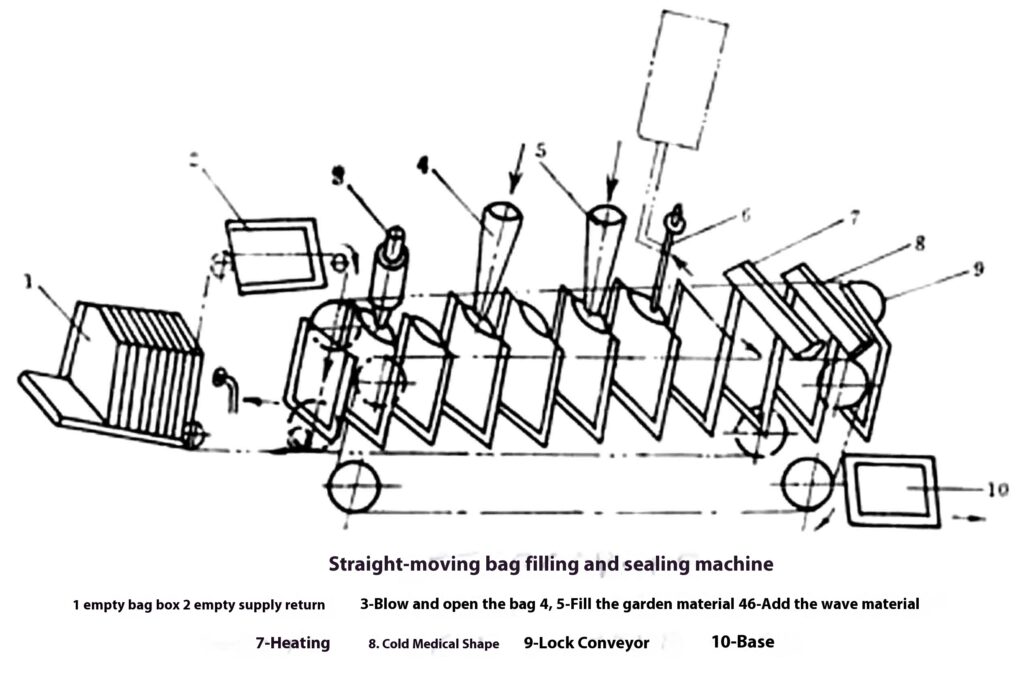
The bag filling and sealing machine can be divided into two types, depending on the path of the conveyor chain: a straight-through type and a rotary type. The first conveyor chain moves the empty bag in a straight line, while the second moves it in a circular motion. However, the operating principles of both are essentially the same. The figure shows a schematic representation of the process for the straight-through bag filling and sealing machine. The bag feeding device consists of a vacuum suction head and a conveyor chain for feeding bags. When the empty bag 2 moves from the empty bag box 1 to the inflating and opening station, the air duct 3 uses the clamping arm of the working chain 9 to blow air into the opening of the empty bag to open it. When the open empty bag moves to the station beneath the hoppers 4 and 5 for solid material, the empty bag is filled with material, or the liquid feed 6 injects liquid material into it. The chain conveyor 9 is equipped with a specially designed clamping arm. Each pair of clamping arms grips one bag. The bag filled with material continues to move and is sealed, cold-pressed, and shaped by the heating element 7; finally, the clamping arm releases the bag, after which the finished product falls downward and is discharged via the discharge conveyor.
The image shows an empty bag that needs to be sealed on three sides. The finished bag is one that must be sealed on four sides. The material used for the bag is either a single-layer film or a composite film. Single-layer film is not used because it is difficult to handle and fill the bag.
Conclusion
Packaging Bags and Vacuum Sealingpackaging machineThey are essential for the food and pharmaceutical industries, ensuring product quality and extending shelf life. Although various types of bags are available for different materials and aesthetic applications, vacuum packaging machines improve the preservation process by removing air, preventing oxidation, and facilitating thermal sterilization. The structure and operating principles of both single-chamber and double-chamber vacuum packaging machines play a key role in streamlining the packaging process, making it more efficient, reliable, and suitable for a wide range of products. Understanding these packaging methods is essential for optimizing packaging processes and ensuring proper protection of products during storage and transport.






 English
 Dutch